Visit Page
Skip to content

Author: Karen Myers

Karen Myers is a fantasy and science fiction author, best known for her heroic fantasy novels. Her stories feature heroes in real and imagined worlds filled with magic, space travel, and adventure.

For the love of god, learn something about historical periods before writing about them

Posted in Irritated Reviews, and Just for Writers

Regency2

I wasn't going to post another Irritated Review™ so soon, but I was reading a Regency Romance novella and I couldn't restrain myself. I'll refrain from naming book or author, but going by the author picture, she's young.

The problems come in two particular flavors: errors of fact and behavior for the period, and modern points of view projected into the past.

Normally I object to these sorts of problems because they throw me out of a book, sometimes violently. In this case, they were so numerous that it was like trying to make out the plot while facing a hail of bullets, one after another. Soon I was no longer reading for the story, but looking for the next blooper, like a game. Here are some of the highlights.

Misused words

There is only the haziest understanding of how a visitor to a town is housed, and it's not in a guesthouse, the term chosen by the author, which does not exist. Inns in villages and hotels in towns are actually what she meant, but other than one reference to lodgings, we keep reading about the guesthouse.

There are waistcoats which are portly (rather than the men wearing them), and brows on ships, where men can stand.

Men want to step onto the “Regent's British soil.” “Regent” is not a synonym for “king” — do you suppose we should be singing “God Save the Regent”?  Later there's a reference to “now that the Regent sat the throne.” Thrones are the seats of anointed kings, not regents, even if they are princes as in this case.

The management of households

The rank of the heroine is never declared, but she is subject to an arranged marriage to the 5th son of a Duke and her parents were the wealthiest in the town, so she must be a member of the lower reaches of the aristocracy, if not higher. Her house is (sketchily) described in matching fashion — it's at least large and well-appointed, though envisioned more as a townhouse than an estate.

And apparently the house has not one single servant.
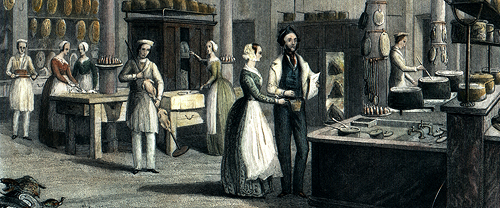
Kitchen staffNo one to bring tea, no one to dust all the furniture, no one to answer the door when someone knocks, no maid to help her dress, no cook, no one to tend the gardens, no one to do the laundry, no one to empty the chamber pots. If she has horses, no one responsible for their care. There is absolutely no one else in and around her house, not so much as a lapdog. And, apparently, no steward or business manager to run whatever estate or business her income derives from. If the income comes from rents, who collects them? If from a business (not appropriate to her presumed class), who manages it, now that her parents are dead?

Did her parents live this way, too? If not, was there a great firing of servants, a casting off of pensioners in the few weeks since her parents' deaths?

She answers her own door, and brings water to a guest. Every thing else about her household must be tended by the brownies, one presumes. I wonder where she gets the milk to pay them?

A rollicking tragic tale

Posted in Other Voices

The Shooting of Dan McGrew herbert blache 11

The Shooting of Dan McGrew: Robert W. Service

A bunch of the boys were whooping it up in the Malamute saloon;
The kid that handles the music-box was hitting a jag-time tune;
Back of the bar, in a solo game, sat Dangerous Dan McGrew,
And watching his luck was his light-o'-love, the lady that's known as Lou.

When out of the night, which was fifty below, and into the din and the glare,
There stumbled a miner fresh from the creeks, dog-dirty, and loaded for bear.
He looked like a man with a foot in the grave and scarcely the strength of a louse,
Yet he tilted a poke of dust on the bar, and he called for drinks for the house.
There was none could place the stranger's face, though we searched ourselves for a clue;
But we drank his health, and the last to drink was Dangerous Dan McGrew.

There's men that somehow just grip your eyes, and hold them hard like a spell;
And such was he, and he looked to me like a man who had lived in hell;
With a face most hair, and the dreary stare of a dog whose day is done,
As he watered the green stuff in his glass, and the drops fell one by one.
Then I got to figgering who he was, and wondering what he'd do,
And I turned my head — and there watching him was the lady that's known as Lou.
 
His eyes went rubbering round the room, and he seemed in a kind of daze,
Till at last that old piano fell in the way of his wandering gaze.
The rag-time kid was having a drink; there was no one else on the stool,
So the stranger stumbles across the room, and flops down there like a fool.
In a buckskin shirt that was glazed with dirt he sat, and I saw him sway;
Then he clutched the keys with his talon hands — my God! but that man could play.

Why inconsistencies in fiction matter

Posted in Irritated Reviews, and Just for Writers

CJBox-OpenSeason
Book 1 of the Joe Pickett series

Another Irritated Review™. I'm just making my way through the 17-book Joe Pickett series by C J Box. On the whole, I like them well enough to buy them (at the grossly inflated traditional publishing prices), but I'm also noting small inconsistencies in factual matters that are irritating enough that I want to expand upon them as a case study in a blog post.

These are mysteries set in Wyoming, and our hero is the game warden Joe Pickett. Each book has an ensemble of continuing characters, and introduces new ones, chiefly to serve as the villains and victims of the particular book — no different from dozens of other, similar series. The writing is professional and reasonably polished, the plots are all right, and the characters suffer the standard long series weaknesses of static personalities or situations — after two decades, you expect them to have matured more than this. All of this is par for the course.

What keeps irritating me are the unnecessary errors of fact regarding the real world, and the unforced errors of prop inconsistencies. (While these are all the author's responsibilities, aren't editors at traditional presses supposed to help catch these?)

Errors of fact

Any genre where the details of the tools or weapons used are important attracts readers who know those tools intimately. It's a truism of the thriller genre that authors dwell lovingly on particular models of guns, for example, and as murder mysteries set in a hunting environment, the Joe Pickett books are no exception.

While I'm willing to give writers a pass on absolute arcana in this area, they need to get the basics right that anyone acquainted with the field would know. Otherwise I'm knocked right out of the story. And it's not just weapons — ordinary tools need to be used correctly, too. For example…

Weapons

Would you twirl this on your finger?
Someone checks out a new very large caliber revolver. It weighs three pounds, and it has a mounted scope. Now visualize this — three pounds is a lot, and a scope on top of the barrel for a handgun means something that's almost as tall as it is long. Got that picture? Good.

Now picture him twirling the handgun by its trigger guard to get a better feel for it. On one finger, necessarily. Now, I'm willing to believe that this is possible, but it would certainly be very clumsy and I can't picture anyone doing it. Can you?

The gunfighters who do this in Western movies are using much lighter guns, without scopes. And they're doing it for effect, not to get a feel for a weapon.

Releasing a series all at once or one at a time — which is better?

Posted in Just for Writers, and Release

fallingdominosI'm just about to start writing a new series. Unlike some of my others, this one is open-ended, rather than coming to a natural (if extensible) close after just a few books.

Is it better to release the new series books one at a time as they're finished, or to write the first several, and then release them quickly, one right after another?

Easy to say — hard to analyze. Lots of uncertainty.

For my own curiosity, I built a spreadsheet to help me do the analysis, and I'm sharing that here with you. As always, I am not responsible for any errors in my assumptions or algorithms — please do your own calculations using your own assumptions.

Assumptions

Time to write a book in the series: 3 months. That's 4 books/year. Sometimes it might be faster, sometimes slower.

I assume my partners (cover artist, conlanger) can keep up. That should only be an issue as the release schedule begins to crowd the writing schedule.

Length of series: Even if I write ahead, the various models end up the same beginning with book 10, so 10 books is enough for this evaluation.

Quantifying uncertainty

To analyze, you need numbers. Those numbers have enormous uncertainty associated with them. Tinkering with the parameters will give you an idea about the sensitivity of the results to the initial setting. Since I'm only interested in the comparative results of different plans, using the same parameters will help cancel out the uncertainty.

Libraries and independent authors

Posted in Distribution, and Just for Writers

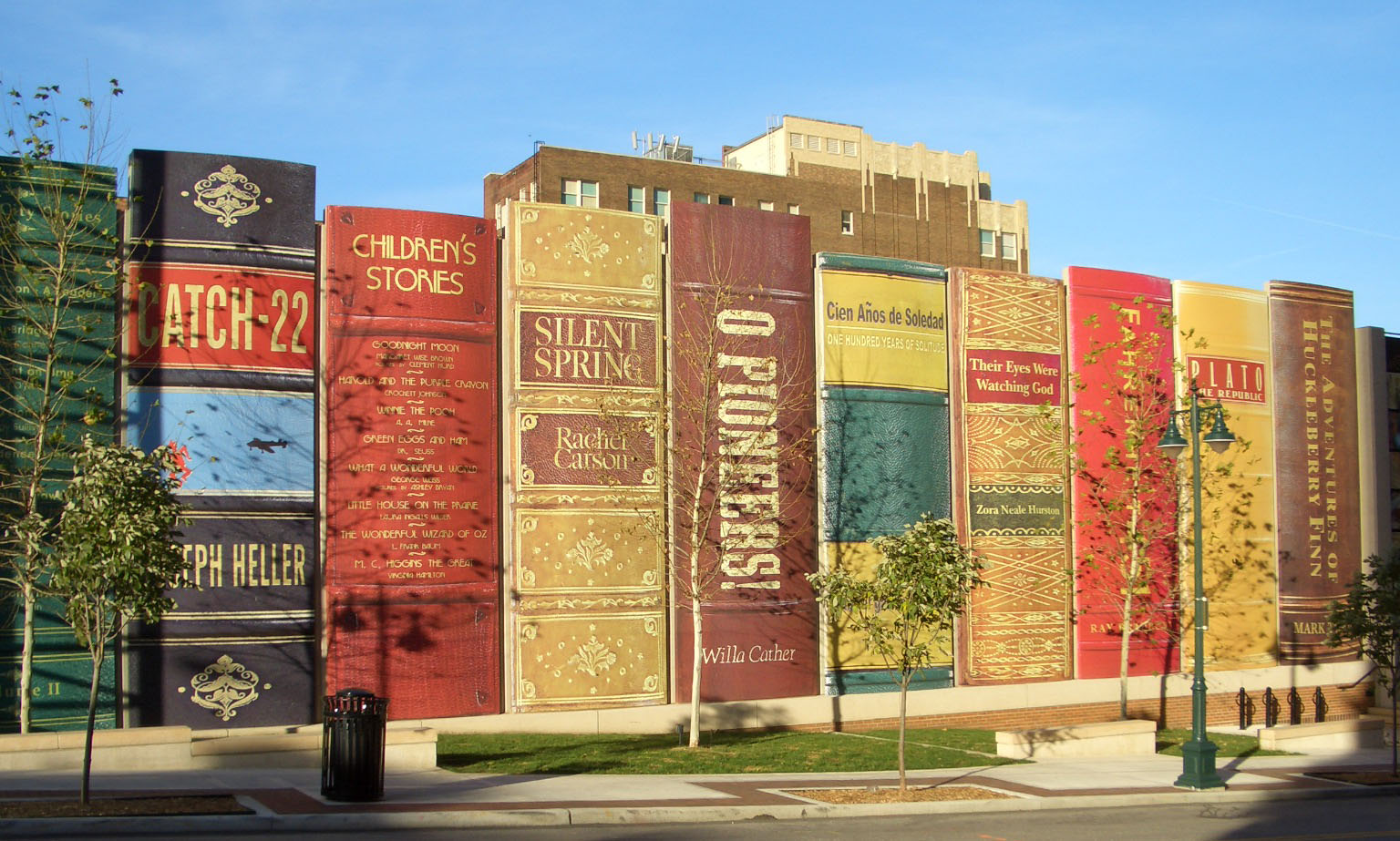
Kansas City Public Library (my old hometown)

As a courtesy recently for my local library's director who wanted to understand more about how she could get indie authors into her library, I put together an overview document for her which I thought I might share here.

This is entirely from the perspective of an old IT entrepreneur turned indie author, not a library distribution insider. But I've seen plenty of business model disruptions in my career, and I think some trends are likely. We'll see… 🙂

Introduction

As an entrepreneur who has spent her entire career building and running small and medium-sized software-related businesses with Fortune 500 customers, I am excited by the rapidly-evolving world that is the independent author movement.

As an independent author with a single-author publishing business (Perkunas Press), I consider libraries an important component of my business.

Many of us (independent authors, aka “indies”) are deeply informed about the publishing industry from the author and publisher perspective, but much less so about the library portion of the industry, and when we speak with our library colleagues, we find that they are also less knowledgeable about the indie movement.

I’d like to change that. This little document is a gift to the Director of my local library, in case she or her colleagues might find it helpful.

I will generalize with a broad brush, concentrating on those indie segments which are the leading edges of opportunities to work together. My own knowledge of library procedures and constraints is limited, and I apologize for any errors there in advance.

The publishing world today

Disruption

What is now typically referred to as the “traditional publishing” industry is in the middle of a classic business model disruption event, similar to the one that hollowed out the popular music industry a decade previously (c.f., the excellent “Ripped” by Greg Kot ).

Like most such events, the incumbent industry is still in denial and unsure of what is happening to them. The upstarts, however, are very clear about what’s occurring.

Sending your books out into the world

Posted in Distribution, Just for Writers, and Publishing

ThrowingBooksI've been coming up the learning curve for the issues of distribution ever since I started writing in 2012. I thought I'd share with you some of my procedures, since my internal “tips” document has just stretched to 10 pages and shows no sign of stopping.

I'm not going to look at marketing at all here. Instead, I'll focus on just the mechanics of getting my books into all the distribution channels I can.

If you note any particular omissions, I'd be grateful if you'd mention them in a comment, or if you would bring up differences for other countries. (Keep in mind I'm based in the United States — your mileage may vary.)

Goal

Worldwide distribution (in English for now) in ebook, print, and audio without going to extraordinary efforts.

I want to create my books, and then fling them out to as much of the world as I can reach. That's the first step. What good is it to make the world's readers want to read them, if they can't lay their hands on them?

Book Bundles

Posted in Formatting, Publishing, The Hounds of Annwn, The Hounds of Annwn Bundle (1-2), The Hounds of Annwn Bundle (1-5), and The Hounds of Annwn Bundle (3-5)

Hounds of Annwn Bundle - 1-5 - Full Front Cover - WidgetBook bundles are one of the great features of the ebook format. It's technically quite easy to bundle several standalone ebooks together into a single ebook file, whether it's a collected teaser of your own works, all the books in a series, or samplers from a group of contributors. Some bundles are constructed for a limited time super-sale, and others remain permanently available at discounted but not giveaway prices.

Over the next month or two, I'll be releasing some permanent bundles for the series books in The Hounds of Annwn. The problem is pricing.

If someone buys all four novels and the short story collection at full price, it costs them $31.95. I'd be happy to sell that as a bundle for 50% off, or $15.99. It's a nice compromise between the number of people who buy all the series books, and those that don't.

The problem is, I can't do that on Amazon, since I'm severely penalized for prices over $9.99, even though it's to the reader's benefit. The best I can do is to offer the five-book bundle on other retailers and directly from my own website, and the two volumes of mini-bundles on Amazon, at $9.99. That's only a third off the full price instead of half off, but what else can I do?

Stay tuned for announcements. The two mini-bundles will be released in August, and the all-books bundle a month or two afterward.
 
Hounds of Annwn Bundle - 1-2 - Full Front Cover - WidgetHounds of Annwn Bundle - 3-5 - Full Front Cover - Widget

Broken Devices has been released

Posted in Broken Devices, Release, and The Chained Adept

Broken Devices - Full Front Cover - 297x459Book 3 of The Chained Adept

CHAINS WITHOUT WIZARDS AND A RISING COUNT OF THE DEAD.

The largest city in the world has just discovered its missing wizards. It seems the Kigali empire has ignited a panic that threatens internal ruin and the only chained wizard it knows that's still alive is Penrys.

The living wizards and the dead are not her people, not unless she makes them so. All they have in common is a heavy chain and a dead past — the lives that were stolen from them are beyond recall.

What remains are unanswered questions about who made them this way. And why. And what Penrys plans to do to find out.

Order direct from the author, or see the publisher for retail sites.