Visit Page
Skip to content

Author: Karen Myers

Karen Myers is a fantasy and science fiction author, best known for her heroic fantasy novels. Her stories feature heroes in real and imagined worlds filled with magic, space travel, and adventure.

After action report — Foxburg Fall Festival

Posted in Events

foxburg-event-img_20161009_153919423-croppedIt was a splendid autumn day, and Foxburg is a lovely little river town along the Allegheny River not far from Pittsburgh. The single riverfront street was lined with vendors in tents selling food and trinkets of all kinds, and alpacas for the petting roamed the library lawn.

The library was a nice, old building, with one large front room, some stacks in a back room, and a tiny alcove for children's books. The library ran a used book sale, and there were eight of us indie authors inside, selling our wares.

Or, at least, that was the theory.

All the signage mentioned “used book sales”. None of it mentioned visiting authors and new book sales. If you weren't in the main room, like me, you were essentially invisible. That would have disturbed me more, except that it became clear after we compared notes that few of us had sold even a single copy of a book.

Our hosts were just as nice and helpful as they could be, but the absence of proper signage meant that few people dropped by, and none were prepared to find anything except used books and had a hard time understanding that there were actual authors there prepared to sell them something else.

Sigh… So after a few jokes about starting up a couple of bridge games, we spent the time sharing stories and tips about writing and publishing. I got some recommendations for other book shows (somewhat sardonically) from one of my neighbors. And we shared lists of books-to-read in various genres.

At least I got to try out all my new gear for setup and display (on a card table). The only hitch was the tablecloth — I bought a rectangle suitable for a 4'x8′ table and expected to have some difficulty folding it neatly for a square 3′ x 3′ table, but little did I know… The cloth, marked “rectangular” in the packaging was actually round. That, my friends, is why you bring large ACCO clamps and tape to show events.

At least I had the opportunity to network a bit with other authors. Here I am with Cindy Marsch, one of my colleagues from the Alliance for Independent Authors.

foxburg-event-w-cindy-rinaman-marsch-img_20161009_172027351_burst000_cover-cropped

Four years in the business

Posted in A Writer's Desk

woman-climbing-tall-mountainD'ya know what today is?

Four years ago I published my first novel, To Carry the Horn. Since then, there have been more than a million words, seven novels (the eighth should be out in November), and a handful of short stories and a collection. That's two fantasy series, and a third in the wings coming up.

It's sixteen titles. When you count up all the different formats and combinations (print, epub, mobi, audio) and bundles, I make it fifty-five published editions, and there are more titles going the rounds of story submissions not yet published.

It's been a wild ride, but I'm just getting started. I've got a science-fiction series in mind after this next fantasy series (The Affinities of Magic). That's eight novels in four years so far, but this year alone I will have published four novels, so I'm ramping up my game.

In terms of the business side, I've just scraped the surface of serious international distribution, and you're all going to be hearing a lot more from me in terms of marketing in the upcoming year, an area too long neglected.

pulling-boulderI enjoy the writing enormously, but novels are marathons, not sprints, and the daily discipline of sitting down and doing the work is always a challenge.

Sometimes it feels like this.

But it's always worth it when I get to the top and release the next book. Love the view from up there!

Bookmarks, business cards, and other stationary

Posted in Artwork, and Just for Writers

2 x 6 Bookmark-VerticalWhenever we send someone a book directly, or sell one at an event, we have an opportunity to include other things. Most commonly, these are bookmarks, which we also distribute wherever we can.

Business cards are also very useful to carry when you're meeting people, or standing around at a convention.

What are they good for? How can we make them maximally effective?
 

Why bookmarks?

Bookmarks are the stand-alone representations of your books. They're popular as leave-behinds in bookstores or at group events, and are the obvious choice for inserts into your books when you sell directly (via online ordering or at trade shows/events).

There is debate about whether all bookstores want them, but many do. If you're not sure, ask.

What's the goal of a bookmark? To interest someone in buying another book. You can't list all your books on a bookmark, as though it were a mini-catalogue. That may seem plausible when you only have one or two books, but it defeats the purpose of seducing the reader with well-designed, professional information.

Instead, set up one bookmark for each series or important stand-alone book. Remember, when you start a series, you may not know how many books there will be, or what their names are. I created the bookmark above (using cover art from the first book) before I wrote a fourth entry and a story collection.

Focus on the first book of the series, name as many of the other books as you can without muddying up the image, and refer to “… and more” after that point. If you create a new bookmark for each series, you can be inventive about including a bookmark for series 2 in a book sale for series 1 to encourage cross-sales. Whenever you have any reason to mail something to someone, include a bookmark and a business card.

And since you may write faster than you use up a print run of bookmarks, future-proof them by using only digital contact information bits, not physical ones. I've moved since I made that bookmark, and I expect to move again before I run out of them.

Why business cards?

businesscard-300dpi-rgbLet's be blunt. If you're in business and you don't have business cards, how do you expect to support a professional impression? A business card is a courtesy to a potential buyer or colleague or vendor. It keeps them from having to write down your contact information themselves.

Better yet, it's another opportunity to sell your product and seduce potential buyers.

Setting up for an author event

Posted in Artwork, Book Signings, and Events

banner-1_7x3-foot-rgbOn October 9, I'll be one of several authors at the Foxburg Free Library in western PA, with a table for presenting my books.

For the first time, I've had to make the effort to get the full panoply of gear necessary for such a thing. This includes, but is not limited to: display stands for books, tablecloth, business cards, bookmarks, newsletter signup sheets, promo pens, a cash box, receipt books, and (of course) books to sell. Not to mention a gear bag to carry things in. Tape, clamps,… you name it. Everything except lamps, table, chairs, and tent.

Naturally I had some of this already, but now I'm treating it seriously.

Here's the banner. Click on it for the full effect (it's 3 feet long).

Drop by the Indie Author Day in Foxburg, PA

Posted in Book Signings, and Events

foxburgfallfestivalSELF-e, which works to distribute independently published work to libraries in the US, has declared October 8 to be Indie Author Day around the country. You can watch a live webcast on Saturday, October 8, at 2:00 EST.

Coincidentally, the Foxburg Free Library, not far from Pittsburgh, is participating in the 13th Annual Fall Festival on Sunday, the 9th, and will be hosting several authors on the premises as part of the festivities.

If you happen to be in western Pennsylvania and fancy spending some time in a lovely autumnal river town, maybe I'll see you there! I'll be giving a talk at 11:00 on “Adventures in writing fantasy.” Come by, pick up a few books, and get any books you already have signed.

A defense of popular fiction

Posted in Genre, and Plot

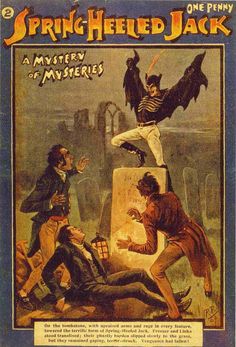
I was reminded today of an excellent essay by G K Chesterton (1901), thoughtfully preserved for us by Martin Ward. Like all such things, the specific references are not necessarily still recognizable, but the core of the essay is both persuasive and witty. Some background on penny dreadfuls here and here.

UPDATE: On the Frank Reade dime novels — some of the earliest Science Fiction.


A Defense of Penny Dreadfuls

G K Chesterton

SpringHeeled JackOne of the strangest examples of the degree to which ordinary life is undervalued is the example of popular literature, the vast mass of which we contentedly describe as vulgar. The boy's novelette may be ignorant in a literary sense, which is only like saying that modern novel is ignorant in the chemical sense, or the economic sense, or the astronomical sense; but it is not vulgar intrinsically–it is the actual centre of a million flaming imaginations.

In former centuries the educated class ignored the ruck of vulgar literature. They ignored, and therefore did not, properly speaking, despise it. Simple ignorance and indifference does not inflate the character with pride. A man does not walk down the street giving a haughty twirl to his moustaches at the thought of his superiority to some variety of deep-sea fishes. The old scholars left the whole under-world of popular compositions in a similar darkness.

RobinHoodTo-day, however, we have reversed this principle. We do despise vulgar compositions, and we do not ignore them. We are in some danger of becoming petty in our study of pettiness; there is a terrible Circean law in the background that if the soul stoops too ostentatiously to examine anything it never gets up again. There is no class of vulgar publications about which there is, to my mind, more utterly ridiculous exaggeration and misconception than the current boys' literature of the lowest stratum. This class of composition has presumably always existed, and must exist. It has no more claim to be good literature than the daily conversation of its readers to be fine oratory, or the lodging-houses and tenements they inhabit to be sublime architecture. But people must have conversation, they must have houses, and they must have stories. The simple need for some kind of ideal world in which fictitious persons play an unhampered part is infinitely deeper and older than the rules of good art, and much more important. Every one of us in childhood has constructed such an invisible dramatis personae, but it never occurred to our nurses to correct the composition by careful comparison with Balzac. In the East the professional story-teller goes from village to village with a small carpet; and I wish sincerely that any one had the moral courage to spread that carpet and sit on it in Ludgate Circus. But it is not probable that all the tales of the carpet-bearer are little gems of original artistic workmanship. Literature and fiction are two entirely different things. Literature is a luxury; fiction is a necessity. A work of art can hardly be too short, for its climax is its merit. A story can never be too long, for its conclusion is merely to be deplored, like the last halfpenny or the last pipelight. And so, while the increase of the artistic conscience tends in more ambitious works to brevity and impressionism, voluminous industry still marks the producer of the true romantic trash. There was no end to the ballads of Robin Hood; there is no end to the volumes about Dick Deadshot and the Avenging Nine. These two heroes are deliberately conceived as immortal.

The reader as partner

Posted in Just for Writers, and Readers

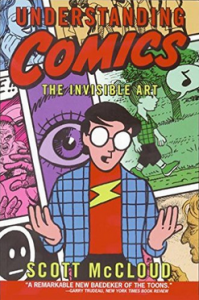
Understanding ComicsI'm rereading a wonderful book: Understanding Comics, by Scott McCloud. If you've never read it, stop reading this post right now and remedy the situation.

I'll wait.

Don't let the fact that he's talking about illustrated work disturb you. His take on how to tell stories is directly related to the writing of fiction in all its forms.

In this post, I'll focus on what he has to say about how the reader is your partner in story-telling.


McCloud-Ax2

As McCloud says about the above pair of panels (p. 66)…

Every act committed to paper by the comics artist is aided and abetted by a silent accomplice. An equal partner in crime known as the reader.

I may have drawn an axe being raised in this example, but I'm not the one who let it drop or decided how hard the blow, or who screamed, or why.

That, dear reader, was your special crime, each of you committing it your own style.

All of you participated in the murder. All of you held the axe and chose your spot.

To kill a man between panels is to condemn him to a thousand deaths.

Let me repeat that — the reader does the work; the artist merely sets it up. If you were writing a bedroom scene, think how little you actually need to show for the reader to fill in the details in ways far more vividly than you can conjure. It's a very clear presentation of how less can be more.