Visit Page
Skip to content

Author: Karen Myers

Karen Myers is a fantasy and science fiction author, best known for her heroic fantasy novels. Her stories feature heroes in real and imagined worlds filled with magic, space travel, and adventure.

Languages for Sale – Part 2

Posted in Just for Writers, and Language

LanguagesForSale-TeleguThis is the second of three posts on how to improve the use of languages in constructed worlds.  Part 1, an introduction of the topic for authors, is here. This part is addressed to folks who invent CONstructed LANGuages: conlangers. The third part of the series, which provides guidance for authors working with conlangers, is here.

IPA-PanicSo, you're a linguist and you like to build languages or even entire language families developing over time. Maybe you'll get lucky, and your language will make it into a hit movie or game or TV series — wouldn't it be nice to turn pro and make a little money at it?

Well, I can't help you with winning the lottery for high-visibility media. On the other hand, just about every movie, game, or TV series that uses a constructed language started life in one or more books. And that's what we're going to talk about here, primarily for the fantasy and science fiction genres.

I'm a writer of fantasy and science fiction, and I happen to have an amateur linguistics background, primarily in the form of dead languages: Egyptian hieroglyph, Sanskrit, Greek, Latin, Old Norse, Old Irish, Old English, Middle High German, Middle Welsh — you get the idea. I know a little bit about the subject from the linguistics perspective, and quite a lot from the author perspective.

I'm going to take a stab at describing a potential market for conlangers (inventors of CONstructed LANGuages) and propose some ways of finding work there. The third part of this series takes the authors' perspective on working with conlangers.

I will be defining some basic concepts for conlangers and painting with a broad brush in the interests of keeping the length of this post within some sort of reasonable limit.

Languages for Sale – Part 1

Posted in Just for Writers, and Language

conlangs

This is the first of three posts on how to improve the use of languages in constructed worlds. Part 2, directed to the constructed language community, is here, and part 3, guidance for authors in working with conlangers, is here.

Writers of fantasy and science fiction have many world-building responsibilities. We have to create and populate worlds, landscapes, ecologies, technologies, cultures, history, and all the myriad of things that go with that. Whether our story is set in the near future, in a galaxy far, far away, or in a place that could never exist, our stories are immersed in a background that must seem rich, plausible, and historically deep — like the real world we live in.

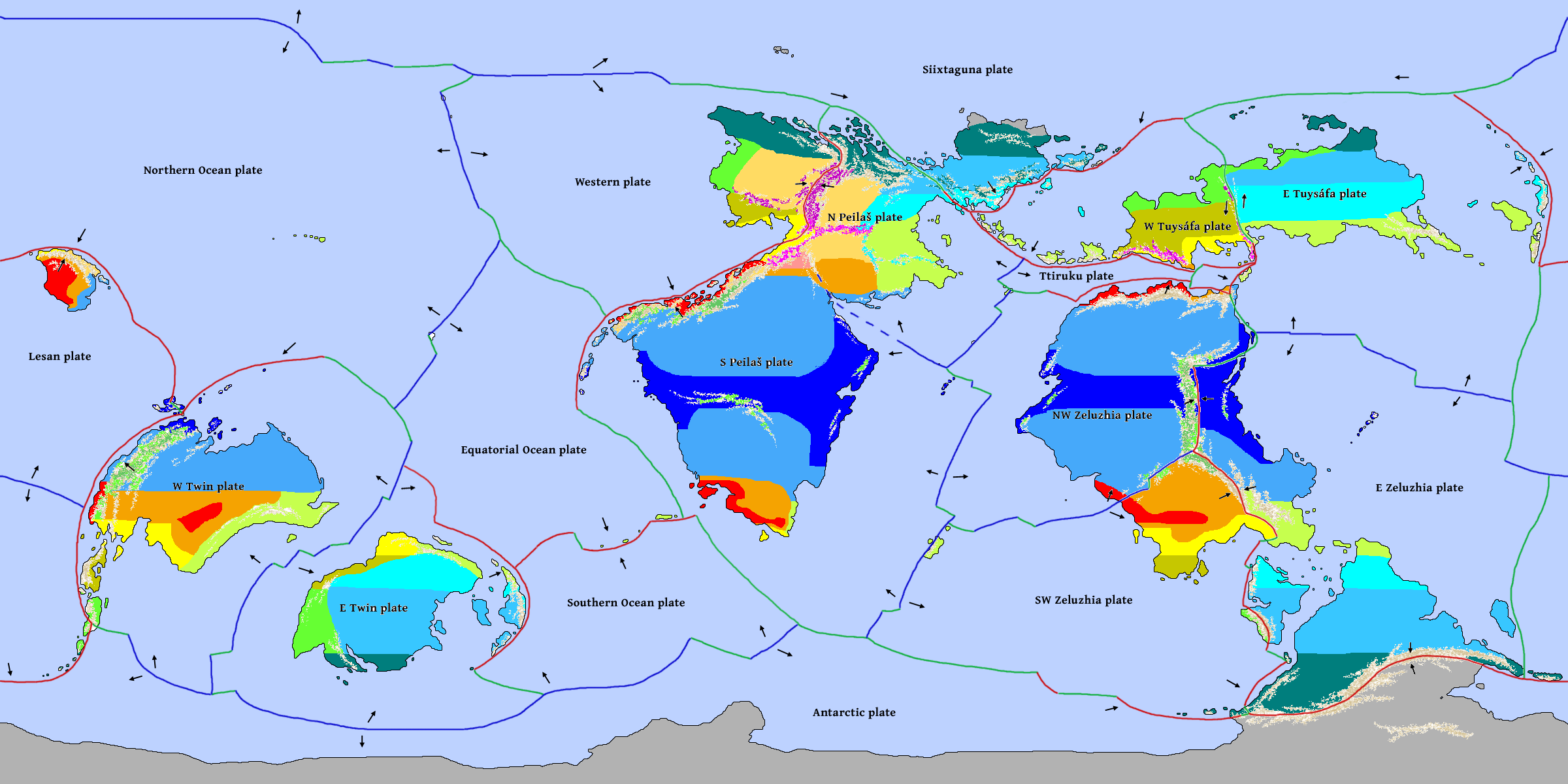
World-building at the tectonic plate level

Many of us play at amateur world-building with maps we hope are not geologically ridiculous, with alien ecologies we hope make some sort of evolutionary sense, and with interactions between cultures that we trust convey some of the flavor of a fictional reality. We look up a few bits of knowledge, here and there, and get a boost from a friend who can critique starship engines re: physics.  All of this is done to make us seem like plausible experts for the purposes of our stories, so that we don't create inanities that pull the readers out of the story (at the very least) and so that we can convey a sense of depth and inevitability and interconnectedness for our story world (at the best).

One of those important threads is language. Most of us are not, unfortunately, historical linguists. In fantasy and science fiction, creating the verisimilitude of cultural depth is a large and fundamental requirement, and most of us are not qualified to fake the linguistic part of that.

We've all read fantasies where the personal names are ridiculous, mixtures of syllables from RPG name generators and ordinary everyday names, with implausible apostrophes and incoherent spellings. These are the equivalent, for some readers, of the lousy book covers we all wince at. Even readers who don't quite understand what the problem is can sense something wrong. And when we start to supply place names, artifacts, and other bits of other languages, the opportunities for maladroit handling just increase. We're not (alas) Tolkien who created entire language families before ever writing the world that used them.

The good news: there are people who do this for fun and profit. The art is called “conlang” (CONstructed LANGuage), and the practitioners are conlangers.

Re-reading old favorites

Posted in Characters, and Heroes

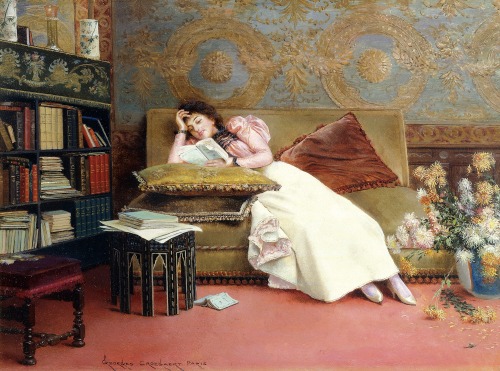
Leisure Hours, (oil on panel) by Croegaert, Georges (1848-1923); 23.5x33 cm; Private Collection; (add.info.: Leisure Hours. Georges Croegaert (1848-1923). Oil on panel. 23.5 x 33cm.); Photo © Christie's Images; Belgian,  out of copyright
Leisure Hours, (oil on panel) by Croegaert, Georges (1848-1923); Belgian

It's a common bit of advice to write the books you want to read, and I think that makes good sense. Of course, if you're going to do that, it helps to understand why you like the books you like, so that you can put more of that into your own stories.

I enjoy many different sorts of books, and I read hundreds each year (no, really) and like lots of them. However, my re-read list of favorites that reliably engage me over and over is actually quite short. It's thoroughly idiosyncratic and includes a few guilty pleasures (like everyone's list).

My frequently re-read favorites

Now don't laugh…

Procrastination, part 2

Posted in A Writer's Desk

See part 1 on this topic.

ProductivityNotTodayThe features of a useful writing procrastination project are that it produces something of long-term utility, and that it has a natural end.

The work I've been recently doing on my genealogy fits, since the information I can pull from records about my family tree (assuming a judicious pruning of remote cousins and in-laws) is finite. You can read about that here.

The second project is larger, but even more finite. You see, I have this website of Scandinavian fiddle tunes…

Blue Rose Music

Twenty-five years ago, in my 30s, I was listening to some Swedish twin-fiddle records (of which I already had a few dozen — now many hundreds). As a harmony singer I've always been a sucker for two- and three-fiddle folk music performances, and the best of these come from the Swedish folk tradition.

I said to myself, “Boy, I like this stuff. Gee, I wish I could do that.” And then the light bulb went off — how hard could it be? I had a musical background and knew my way around a piano and a guitar (as an amateur).

So, I picked up a violin for the first time, just to play the Scandinavian folk repertoire, and never looked back.

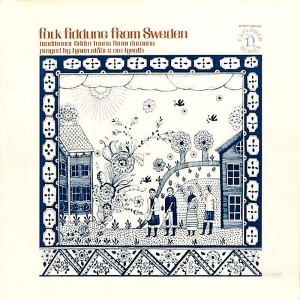
The Nonesuch recording that sucked in most Scandie musicians of my generation
The Nonesuch recording that sucked in most American Scandinavian musicians of my generation

You can read about this in some detail here, but the short version is I've been going to workshops and playing solo and with small bands now for a very long time, primarily for the use of dance groups who are equally fond of the folk dance traditions of Sweden and Norway.

Playing for dances in pick-up groups means you carry around huge binders of material because the repertoire demand for all the dance forms is very large in the Scandinavian genres. It's not like, say, Irish, where if you know jigs, slip-jigs, reels, waltzes, and polkas, you're covered for most dance requests. No, the tune categories alone are broad, and many of those categories cover several different dance types with different musical requirements.

I improved the situation by using early digital music printing programs to create binders of incipits, the first bars of each part of the tune, to serve as quick hints for what tune to play next for dancers.  Then, naturally, I put up a website, Blue Rose, where those lists of incipits went online, with links to PDF files for each tune, so that people who played together regularly could find them. When I went to workshops, I posted the tunes we learned for everyone to use.

Over time, this grew…

There are now 2000 Scandinavian fiddle tunes in my binders and up on Blue Rose.

What’s the point of an author website?

Posted in Just for Writers

WebsiteDesignThere are plenty of gorgeous websites out there for books and authors, but I think that a surprising number of them miss the point and frustrate their readers and potential buyers.

Over time, I have evolved some firm opinions about what should be on Author and Publisher websites. It seems only fair to put them up here so that others can shoot at them.

In brief, the point of an Author website is to own and control all the information about your products so that you can tell readers what they want to know and turn them into fans who will buy your next book. It's really that simple. Almost no one builds their first Author website with that in mind, however, and it can take quite a while for them to clarify what they're doing with it.

Let's explore what that mission statement means, in a 4-page post…

Procrastination, part 1

Posted in A Writer's Desk

See part 2 on this topic.

ProductivityNotTodayIf I were a rational human being, I'd sit and do my 4-5 hours of writing every morning without a quibble. I like writing. Being a normal human being and not a rational one, I instead find a myriad of other things to occupy me, all apparently fascinating.

So I resort to tricks. The most effective of these is to channel the desire to punt into other productive work. Better almost anything (I tell my subconscious) than just to play games or read. Best of all if I can tell myself that the alternative projects are finite.

There have been two big (but productive) writing procrastination sinkholes recently. Here's the first one; I'll save the second one for a separate post.

Genealogy

I was raised by wolves. Nice wolves, but still… There were no family stories around the dinner table. None. I had the equivalent of a single sheet of paper for both sides, together, and not a full sheet of paper, either.

Considering that my father had lots of aunts, uncles, and cousins, and that my mother was a war-bride from Antwerp, you'd think they'd have something to talk about, like the time Aunt Bertha did this, or the time Grandpa Louis François said that. Or even just the stories of how they met during the war. Not so. The only family story I ever heard about came from my father's sister. I met my two aunts (one on each side) and their children a few times, and that was about it. I couldn't name, with certainty, my own grandparents, much less their siblings.

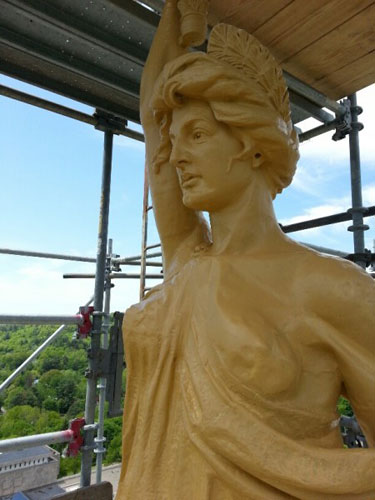
ClaraMaine-preRegild
Great-grandmother Clara Gasperov Myers, about to be re-gilded as the Statue of Wisdom on the dome of the state capitol building in Augusta, ME

When I put out that story about my great-grandmother, I sent a link to my father's niece and asked her to forward it to any relatives she knew. Lo and behold, cousins on my father's side sprouted from the woodwork. They all know each other, more or less, and haven't quite understood that I didn't know who any of them are. So when a free trial arrived for Ancestry.com, I went to work with what little I knew.

I was able to pin down more of the connections between my great-grandparents on my father's side. (It helps that the two Jewish lines arrived from Odessa (father's father) and Germany (father's mother) at about the same time, into the land of census records and Massachusetts Masonic membership cards).

When I stumbled across someone else's family tree that included my great-grandmother Clara, I contacted them and passed along a link to the story about her. That got me connections to another bunch of cousins, as well as a professional genealogist who specializes in Jewish immigration (mother of a family in-law), and that side of the tree firmed up nicely. I didn't get any further back (some but not all of my great-great-grandparents), but it certainly got very broad with all their descendents.

Even the dry bones of demographics have interest. There's got to be a story behind the 3rd cousin who married on her 18th birthday, though I'll never know what it was.

Win free ebooks on May 18

Posted in Events

I'm participating in a Facebook Party for a new release of The Roar of Smoke, a book by Candace Carrabus.

Every half-hour, from 12:00 – 8:00 EDT, a new author will join the Facebook page and offer prizes and ask a question/sponsor a discussion. The winners of the prizes will be picked from the participants.

Here's the list of participating authors and prizes, along with their time slots (in Central time). To join the event, click here.

I'll be on from 4:00-4:30 CDT (5:00-5:30 EDT), and I'll be giving away 5 ebooks of To Carry the Horn, the first book in The Hounds of Annwn series. If you already happen to have that, I'll be glad to substitute any other book, or the next one to be published.

Lots and lots of books being given away — go check it out!