Visit Page
Skip to content

Author: Karen Myers

Karen Myers is a fantasy and science fiction author, best known for her heroic fantasy novels. Her stories feature heroes in real and imagined worlds filled with magic, space travel, and adventure.

Every story needs its own world

Posted in Artwork, Fantasy, Science Fiction, Setting, Structures of Earth, and The Affinities of Magic

Every story needs its own world and, if you're writing fantasy or scifi, that world has to be built.

I started Structures of Earth not quite two years ago, then put it on pause to write the Chained Adept series first (see background). At the time, I had a vivid image of the river town where the action was happening — the capital city for the country in which the story is set, rather the way London functions for England.

But where was that country, and what place in what world did it occupy?

One thing I learned from The Chained Adept — it's fun (and not too hard) to build a world map for a series and much better to do it at the start rather than to try and retrofit one after most of the story is done. That way, the “real world” constraints can ground the story and drive some of the plot logistics issues.

The world of The Affinities of Magic is a new world, and it needs its own maps. I took Fractal Terrains 3 out for a spin last night and started seeding the world settings until I found one I liked.

The world of The Affinities of Magic

Here's what that globe looks like if you unroll it, with a pointer showing where my temperate northern hemisphere initial city is located. (I haven't designated any national/imperial boundaries yet.)

One thing is already clear — there will be large differences between the cultures on the inner sea and those with access by water to the rest of the world. That inner sea may be 4200 miles wide, but it's still a restricted body of water, warm equatorial water, and the ecosystem in and around it will be unique.

See? That's something I didn't know before I generated this map. Hadn't even thought about it.

Restarting a series

Posted in Characters, Fantasy, Structures of Earth, and The Affinities of Magic

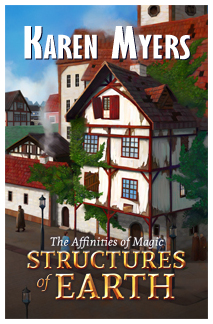
Book Cover - Structures of Earth, from The Affinities of Magic seriesI was about a quarter of the way into Structures of Earth when I put it aside in late 2015 to write a different series: the four books of The Chained Adept, the 4th and final book of which was just released.

Why would I do that, interrupt a series?

Well, there were several issues…

Series longevity

I intend for The Affinities of Magic to be a longish series, the way a detective series is. The characters will grow over time and their role in their world will evolve, but the focus will be almost exclusively on each individual story rather than an overall series arc. There are long-term issues that drive some of the characters, and those will show progress (or setbacks) across the books, but not an integral sort of series arc, the sort you're accustomed to in a trilogy, say, where you must “destroy the ring!” or achieve whatever goal you started with.

Some detective series work this way (the ones that don't just reset the characters with each new entry). Each book has a problem to solve that is important to the characters, but in the background the hero is getting older and having problems with his marriage, and an old flame shows up and then goes away again, and he gets wiser (or not) about how to handle certain situations, and so forth.

In The Chained Adept and The Hounds of Annwn series, there's an overall story arc to the entire series, though each book is a complete story of its own. For the former, that arc is probably completed, but for the latter — who knows? Might get longer. I have ideas…

World building to last

Creating a series like that meant I had to approach world building and character building (especially teams) for the long haul. Longer than four books, anyway.

I put some serious work into the technology of magic underpinning the “rules” by which the guilds (and others) operate, since the fundamental premise of the series is that they follow someone who is the “young Tom Edison” of magic — someone who figures out why the rules work the way they do. The whole series background is set in the resulting industrial revolution caused by these discoveries, with our hero at the center of it. I've always enjoyed technology of magic issues — perhaps that's a reflection of my fondness for hard science fiction.

All that is very interesting, but you can't tell stories about concepts. Stories are about people.

On a Crooked Track has just been released

Posted in On a Crooked Track, Release, and The Chained Adept

on-a-crooked-track-full-front-cover-297x459Book 4 of The Chained Adept

SETTING A TRAP TO CATCH THE MAKERS OF CHAINED WIZARDS.

A clue has sent Penrys back to Ellech, the country where she first appeared four short years ago with her mind wiped, her body stripped, and her neck chained. It’s time to enlist the help of the Collegium of Wizards which sheltered her then.

Things don’t work out that way, and she finds herself retracing a dead scholar’s crooked track and setting herself up as a target to confirm her growing suspicions. But what happens to bait when the prey shows its teeth?

In this conclusion to the series, tracking old crimes brings new dangers, and a chance for redemption.

Order direct from the author, or see the publisher for a growing list of retail sites.

Taking stock of 2016

Posted in Goals

Still Life and Street, M.C. Escher, 1937It's time to look back on 2016 and take stock — what worked, what didn't, and where I spent my time.

Accomplishments

I almost tripled 2015's word count, though my total of 343,000 fell just short of my target of 365,000.

For the first time, I managed to publish four books in eleven months — an entire series (The Chained Adept: 2/2016 thru 1/2017). The whole thing was an experiment in writing as a “pantser” (by the seat of my pants), without an outline (other than the basic inflection points of the story). I liked the freedom of the process and will continue that way.

I also packaged up and released two book bundles for the Hounds of Annwn series and expanded my international distribution.

Word Count 2016

Posted in Goals

table_abacus-gregor_reisch_margarita_philosophica_1508

Always good to know what the numbers say…

Words of fiction

2016 – 346,258
2015 – 119,603
2014 –   65,736
2013 – 210,470
2012 – 270,600

Total – 1,012,657


Goal for fiction for the new year

2017 – 365,000

Blog posts

2016 – 43,429
2015 – 30,619
2014 – 34,214
2013 – 28,714
2012 – 18,347

Total – 155,875

On a Crooked Track (excerpt) – Chapter 1

Posted in On a Crooked Track, and The Chained Adept

Wood everywhere—the solid pier on which Penrys was trying to find her land legs, the ship moving gently beside it in the harbor at Ellech after almost two months at sea, and the entire forest of a city spread out before her, topped by the clusters of signals towers like groves of mountain spruce trees.

It smelled like home, all that wood—weathering away in the buildings, or freshly cut in the long arm of the hoist that was even now swinging cargo off the ship, or burning as firewood and flavoring the crisp spring breeze.

Home was in the woolens everyone wore, retentive of the odor of hard work and dinners long past. It was in the hair and beard dressings of the dock workers, leavened by the exotic aromas of some of the southern cargo, destined for the perfume manufactories.

Penrys inhaled deeply, feeling the rightness of the environment deep inside her. She hoped they’d have a few days to spend in the harbor cities at the base of the two rivers before moving upriver to Tavnastok so she could get started doing her research at the Collegium, but that would depend on her mentor, Vylkar, visible on the wharf at the end of the pier making arrangements for their cargo.

Najud and Munraz were having troubles of their own adjusting to an unmoving surface. “Come on,” she said, picking up her pack. “The sooner you start walking, the easier it will get.”

“Does it work that way for you?” Munraz asked, gamely lifting his own gear.

“Don’t know—I’ve only read about it.” She chuckled at his outraged expression. “I’ve never been on a ship before, not at sea. Never been in Stokemmi, either.”

Striding off down the pier, she called over her shoulder, “Let’s go explore.”

She made a game of anticipating exactly where her feet would meet the planks until her body adjusted to the change of terrain and she stopped stumbling. Her footing wasn’t improved by her hard-soled boots, donned for the first time in a while after the bare feet or soft shoes of shipboard life.

The three of them clattered to a stop behind Vylkar. Two piles were accumulating before him as they came off of the hoists. The larger one, goods destined for trade here in the city, were to be stored in the warehouse used by the Collegium for its own supplies. Cargo handlers were stowing the horse packs onto two wagons to move them there, and the draft horses waited patiently, their breath visible in the chilled air.

The laborers joked with each other as they worked, swapping insults that would bring a blush to a hardened campaigner. Many ships were in harbor, and this wharf, one of several, was busy, filled with people earning a living and working up a sweat doing it.

It was noisier, smellier, and far more vivid than the river harbor at Yenit Ping, and Penrys wondered what Najud and Munraz made of it. Except for the sea at their back and the size of the city, it could almost be Tavnastok, two hundred and fifty miles upstream from the mouth of the Lodentaf, just visible as a gap in the wharves far to the west along the shoreline. She’d seen sights like these there, running errands for the Collegium.

Their personal bags went into a hired two-wheeled pony cart. They would walk alongside it toward the center of Stokemmi to wherever they took rooms.

“We’ve fallen into the hands of talking bears,” Najud muttered. “Loud, smelly bears. Great big tall ones.”

“I warned you about the beards.” Penrys surveyed the wharves with a stranger’s eye and noted how many people were clearly natives (most of them), male (most of those), and bearded (all but the children). The few men of other nations, mostly officers from some of the ships in harbor, looked astonishingly youthful with their shaven faces.

“You’ll find plenty of foreigners here, and they shave,” she told them. “I was never sure if that was out of fastidiousness, or because they couldn’t raise a competitive beard and were afraid to try.”

Some wore their beards in braids, or loose down their chest. Others had neatly trimmed, no-nonsense specimens. And here and there, especially for the citizens who’d come down from the city on business, elaborate grooming and stiffening fashions were on display.

“Do they breed for it?” Munraz asked, in a hushed tone that said he wouldn’t be surprised by an affirmative answer.

“Hard to say. The boys compete with pride to see who can sprout first, and survey their fathers and older brothers with envy. Maybe the less hairy ones have had a harder time finding a bride, and so they’re all bearded now.”

She smiled at the open alarm on his face. “Don’t worry, you can keep a beardless face and foreign clothing—no one will think it strange. Foreigners mean money, here—trade and business and interesting foods.”

Najud looked unconvinced. She wondered if he thought he had to cultivate a beard to measure up, and then she wondered if he could. She’d seen him in stubble, but she’d never seen a bearded Zan, just the somewhat patchy results of a couple of months of neglect. That would never work here, in Ellech, and they didn’t expect to be here any longer than that. Better to choose a different display of manhood.

Ah, but how do you tell a man that? She suppressed a smile.

Grimdark vs noblebright

Posted in Heroes

stgeorgeThe words grimdark and noblebright arose as technical terms in the gaming world. There's a certain amount of dispute about the exact definitions there, with a tendency to paint them in black and white terms (such as the slur that noblebright is all about rainbows and unicorns and flawless heroes).

In fiction, by contrast, especially adventure fiction (in which I class things like Westerns and Fantasy) they have come to be used to reflect two different and opposed styles of story. Since there is some dispute about the definitions, it behooves me to offer my own.

GRIMDARK

The notion that the actions of one person can do little to improve this world in decline, that the forces of evil and inertia and temptation will ensure that all of us are doomed. The best we can hope for is a little struggle with morally ambiguous heroes to oppose danger and maybe rescue for a brief time a few others.

NOBLEBRIGHT

The notion that the actions of one person can make a difference, that even if the person is flawed and opposed by strong forces, he can (and wants to) rise to heroic actions that, even if they may cost him his life, improve the lives of others.

Let me explain why I am firmly in the noblebright camp.

Asking for book reviews

Posted in Just for Writers

book-review

See that illustration? You know what's wrong with it?

Readers don't owe anything to authors, including thanks, and we shouldn't presume that they do if we want them to continue as customers.

At least, that's what I think. And here's why.

Authors often seek recommendations on what to include in the back matter of their books. The potential list is long:

  • Thanking the reader
  • Asking for book reviews
  • Pointing the reader at links for more information about the book they just read
  • Offering the reader a newsletter to subscribe to, for information about books (with perhaps a bonus giveaway)
  • Offering the reader a way to contact the author (sometimes including links to social media)
  • Telling the reader about the next book in a series, or about another book
  • Presenting the first chapter of the next book in a series, or another book

One of these, the “ask for review,” was recently in the news as something that traditional publishers have begun including in the back matter of their books, apparently learning from independent authors.

When I first published my books in 2012 and for a couple of years thereafter, I also asked for reviews in the back matter, just as a standard practice, but I've stopped doing it.

Why would I do that? Don't I want them to leave book reviews?

Let me explain…

Of course, I would like to have more reviews — who wouldn't? But what I would like, even more, is for someone who has just finished a book to be eager to look at and buy my other books. That “bird in the hand” of a satisfied reader is far more important to me than another drop in the review bucket for a potential reader down the line. My customer is a customer first, way ahead of being a member of my marketing team.

I think asking for the review smacks of desperation and comes across as a bit unprofessional. I don't want my reader to start thinking of me that way.

And you know what? It doesn't make any difference to the number of reviews I get, near as I can tell. The review rate seems to be about 1-3% of units sold (I don't do freebies), and that seems to be good across most current and active authors, trad or indie.

Think about what that means… That means that 97-99% of my readers didn't leave a review. And every one of them probably felt a bit uncomfortable about it, if they read the request. Did that make them less likely to buy another book? Who knows?

Here's my take on the psychology of it (aside from the vibe it sends)…

If the person is accustomed to writing reviews, then they'll write one or not, regardless of what I say, just as if it were any other author's book.

But if they're not so accustomed, we're asking them to change their behavior to accommodate us. We're asking for a favor. But that's not the transaction deal our readers make — the deal was, they give us money, and we give them entertainment.

Not everyone wants to learn a new behavior

It's as though we only published ebooks and asked people who only read print to learn how to use a new format just so they can access our books. That's asking them to change behavior, too.

Unless we are in the “super-cool, new trend” category and we've encountered a techie (and even then), asking people to change their behavior to do us a favor isn't really going to work. And it may embarrass or guilt the recipient, which is not how we want them to think about us.

Better to just thank them, give them the “for more information” and newsletter signup links, and send them on to the “1st chapter of next book” with its link so they can buy the next one while they still like us.

That's more important than a book review any day.