Writers of fantasy and science fiction books have special needs. Not only do we have characters to create from scratch, like every novelist, but we have entire worlds to build — not just the verisimilitude of the historical past, but entire planets, spacecraft, or fantastic realms. Our desks are littered with bad sketches of landscapes, terrible character portraits, and far too many scraps of idiosyncratic cosmogenesis.
You know who else has these problems? Dungeon masters.
“Old school” dungeon design software
The world of Dungeons & Dragons and subsequent games created a need for game masters, those referees who control the world of their game for their players, to make maps, create character cards, and so forth. Not surprisingly, there’s an ecosystem of software to support this.
A couple of months ago, I invested in most of the software modules from ProFantasy and started playing around. I needed to design a complete secondary world for a new series, The Chained Adept, and it wasn’t going to be modeled on Earth at the geology level (although I planned to keep the flora & fauna so that the readers wouldn’t need to master an entire ecosystem of vocabulary).
I started by designing a planet, using Fractal Terrains 3. By providing a handful of parameters and tinkering with the results, you can create an infinite number of alien planets.
In addition to the novels I’m currently working on, I’m making a practice of producing more short stories and submitting them to various magazine and anthology markets. Rather than just search for random topics, I’ve decided to write as many of them as possible for ultimate inclusion in a single collection, called There’s a Sword for That.
As you can see from the progress meters on the right, there are four stories so far. This is a science fiction collection, not fantasy, somewhat unexpectedly for stories with swords in them. So far, they’ve included children, sessile tentacular creatures, intelligent multi-purpose devices, and a famous historical kris (not all at once, of course).
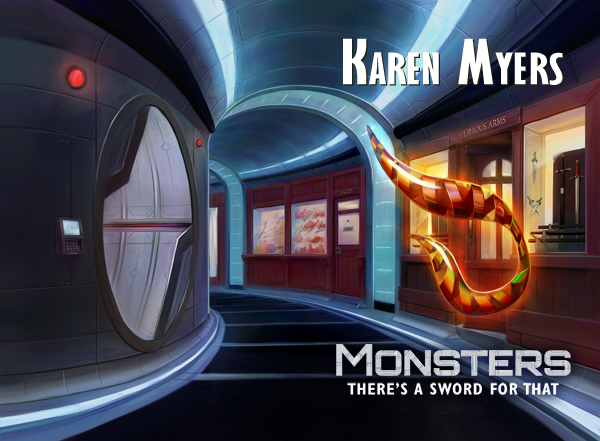
There’s a frame to this collection — the Curious Arms weapon shop, tucked away on a space station. All the covers will show the weapon shop and one of the weapons (the cover for the collection will include a rosette of all the weapons).
As each story completes the submission process and becomes available again, it will be published by Perkunas Press, and eventually the entire collection will be available as a book, too. That’s more than a year away for some of the stories, but at least a few should be available this year. Since I like to get the covers done sooner rather than later, you can at least get a preview of what they’ll look like.
I’ve spent the last few months conducting a number of experiments and thought I’d mention them here.
Look for a summary of 2014 and plans for 2015 in separate posts.
Finally, I’ve decided to add progress meters (on the right) for short stories still in the submission process. When finally published by Perkunas Press, they will have full pages here and on the Perkunas Press website.
Social Media
I conducted a blitz for four months aimed at improving my Facebook and Twitter audience. Rather than advertising my books (bad form) except for the occasional sale, I focused on providing interesting content covering a wide array of topics. In other words, I posted about the things I like — archaeology, landscape, language, surrealism, and dozens of other subjects.
My Facebook friends said, “hey, neat!” and hardly grew at all. Twitter, on the other hand, where I had little presence, grew to hundreds of followers. That was gratifying, but the advice to “make friends and have conversations” still eludes me. I’ve found new people to follow, but conversations don’t seem to make sense in that medium.
I also dabbled in Pinterest and lined up Tumblr and Instagram to explore, but I’ve eased up on this for now. When my next book is published, I’ll do announcements on Twitter and Facebook, and see if I can detect any impact, especially from Twitter. If not, then this is not a great use of my time, and I should ratchet back to a more normal level (yet to be determined).
This blog has suffered as a consequence. I expect to be posting more regularly, and with a greater focus on actual news rather than just amusements and general items of interest.
Workshops & Lectures
I’ve become a real devotee of Dean Wesley Smith‘s workshops and lectures. His somewhat acerbic and dismissive manner sometimes requires accommodation, but he and his wife Kristine Rusch have an invaluable perspective on the publishing industry and the important issues for long-term fiction writers. It’s always difficult to find a mentor whose sensibility accords with your own, and these two do it for me, covering both craft and business concerns.
Sometimes I’m asked, “How do you come up with these invented worlds so you can write about them?”
I don’t think that’s the right question. I think the real question should be, “How do you make these invented worlds seem real?”
I’m working on Structures of Earth, the first book in the series The Affinities of Magic. I plan to write several books in this series, and I’m approaching the first book as the foundation story, the prequel to the long string of stories to follow. I have a plot and a team of characters, and a good bit of the book written, but for the last while my brain has been raising alarms, saying “Stop. Something’s wrong.”
The Fantasy and Science Fiction genres are distinct in several ways, but there is a certain degree of overlap as well. Both of them specialize not in things as they are but in things as they might be. They may differ in where the emphasis of the story goes — SF is notorious for typically making “the idea” and its consequences the point of the story, not necessarily the characters — but in this post I want to concentrate on what they have in common.
I’ve read SF&F all my life, and the two genres are cross-fertilized for me now. I like my SF best when it has moral characters as well as ideas, and I like my Fantasy best when its magical or supernatural elements are treated consistently, as though they were science.
It’s a truism in an SF story that you can change just one thing arbitrarily (time travel works, men live for centuries instead of decades, there are sapient aliens we can meet) and, if you can do an adequate handwave in the direction of scientific plausibility, the reader will accept it, as long as the notional basis is scientific (rational). For example, there may be religion in SF societies, and there may be powerful beings who seem to be indistinguishable from gods, but you can’t have real gods (supernatural entities) as agents in SF (though you can have a belief in them). That’s because god(s) may or may not exist, but science has nothing to say on the subject. That’s why they are literally “supernatural”, not “natural”.
What you must do in SF, however, is deal with the change consistently, e.g., if men live for centuries, there will be social and economic consequences. The story can be about those consequences, or they can be a background to the story, but they must be consistent, and a very great part of the pleasure of reading SF is the exploration of the consequences of such an idea.
Fantasy is a broader category. It accepts that those areas where it differs from quotidian reality may not be capable of rational explanation. Hence you can have supernatural entities (gods, elves, demons) as well as beings that might or might not be supernatural (vampires, werewolves, dragons).
I’m in the midst of the first book in my new series (The Affinities of Magic), and it’s a very different writing process from my previous book, which was the fourth in its series (The Hounds of Annwn).
I’ve gotten to know my primary characters in the older series pretty well. I know what they would and wouldn’t do, and a good bit of how they interact with each other. In other words, I’m comfortable with them.
In novels of adventure, the sort of thing I write, you need a good story, a sound plot, and it’s a good idea to have the basics of that in your head before you begin writing. Perhaps the details are hazy — maybe you don’t know exactly how certain things are going to happen — but I find I need at least a sketchy outline of the key plot points before I can start. Some authors are comfortable just writing into the void, but I’m not one of them. (The lessons of Wile E Coyote are all too vivid.)
Plots in and of themselves don’t scare me. I used to be a serious software engineer, and what is that but the instantiation of a fully realized product where all consequences are knowable (at least, after debugging).
But story comes from characters, and that’s my current sticking point. Who are all these people?
Short stories are more like molehills than mountains
I find that long-form works like novels seem to match well with the sorts of stories I like to tell — multiple characters, various sub-plots, threads to be woven together. I wouldn’t dare try to keep two novels going in draft simultaneously. It would be like listening to two engrossing conversations at once, and impossible to keep track of.
But sometimes you just want a break. For me, that means writing short stories. Any shorts I write for my ongoing series will probably go straight to publication, but I’m also beginning to produce stand-alone short stories. Since the current series are in the fantasy genre, I’m doing the shorts mostly as science fiction, just for a little variety. Some are truly stand-alone (Second Sight), but others (Buntel Mayit, Monsters) are intended for a story collection called There’s a Sword for That, all of the stories for which will involve some sort of edged weapon. (Since swords are usually associated with fantasy, I thought it would be a challenge to produce science-fiction sword stories instead. That involves a wee bit more than just declaring, say, dragons to be aliens and getting on with it.)
You won’t see these stories for a while, since each one is going through the magazine submission process, and that takes quite a bit of elapsed time (more than a year, maybe two). But I expect to put a dozen or more stories out this year, and I entertain myself prior to publication with getting their covers done as I write them, so that there won’t be anything left to do after they come back unbought or their rights expire, if bought. At least I get to put the covers and blurbs up that way. And if I keep this up every year, there will soon be a regular stream of submissions coming back for publication — I’m just filling the pipeline this year to reap in the future.
Paring it down
Aiming for a certain size in a short story is not something I can control. They’re as long as they need to be, seems to me, and each one is different. Monsters, the latest story destined for the sword collection, surprised me by being only three pages long (1000 words), just two scenes, what they call “flash fiction”. My beta reader wanted to know what happens next, and perhaps you could spin a long story or novella out of it, or it could be the start of a longer character-based novel — sure, I could see that.
But sometimes a molehill is just a molehill, not a mountain. If the characters come back and start explaining their life story to me, well, maybe there will be a followup. Meanwhile, I like the unanswered questions that spin off from the brief encounter. Gives it a concentrated flavor, like a wound-up spring.
Over the next year or so I will be writing a dozen stories or more for a science fiction collection called There’s a Sword for That. It will feature bladed weapons, one per story, in unusual contexts, tied together by the shop that houses (and sells them) aboard a space station
The first story is Buntel Mayit, a tale of an ancient and famous keris (kris) cursed by the shaman/smith who was its first victim. Far in the future, it is still seeking revenge on dynastic opportunists. Captain Frans Krajenbrink, Keris Mpu Gandring, and the freighter Ken Arok out of New Java have a fateful encounter with an ambitious alien.
Each story will go through the submission process for magazines before being published by Perkunas Press, so it will be a while before you can read them. I’ll keep everyone posted as soon as any story becomes available in either magazine or Perkunas Press versions.
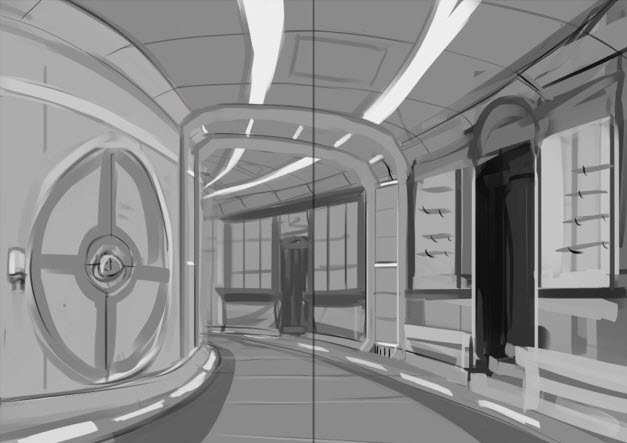
Meanwhile, here’s a look at the very first draft sketch for the cover of the collection, featuring the sword shop, from artist Jake Bullock who provided the cover for The Affinities of Magic.