Karen Myers is a fantasy and science fiction author, best known for her heroic fantasy novels. Her stories feature heroes in real and imagined worlds filled with magic, space travel, and adventure.
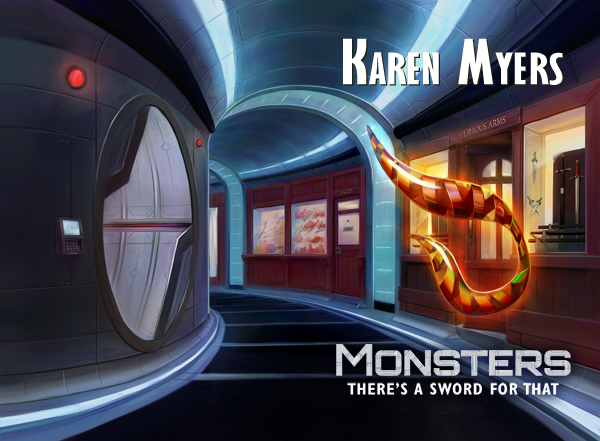
In addition to the novels I’m currently working on, I’m making a practice of producing more short stories and submitting them to various magazine and anthology markets. Rather than just search for random topics, I’ve decided to write as many of them as possible for ultimate inclusion in a single collection, called There’s a Sword for That.
As you can see from the progress meters on the right, there are four stories so far. This is a science fiction collection, not fantasy, somewhat unexpectedly for stories with swords in them. So far, they’ve included children, sessile tentacular creatures, intelligent multi-purpose devices, and a famous historical kris (not all at once, of course).
There’s a frame to this collection — the Curious Arms weapon shop, tucked away on a space station. All the covers will show the weapon shop and one of the weapons (the cover for the collection will include a rosette of all the weapons).
As each story completes the submission process and becomes available again, it will be published by Perkunas Press, and eventually the entire collection will be available as a book, too. That’s more than a year away for some of the stories, but at least a few should be available this year. Since I like to get the covers done sooner rather than later, you can at least get a preview of what they’ll look like.
It’s wintertime, there’s a helluva lot of snow on the ground, and my 4WD car is in the shop. So, when it comes time for groceries and the liquor store, we have no alternative but to take our big old Ford F150 pickup truck, with its snow plow attached, down off the mountain and go lurching into town.
It looks a lot like the picture, but decades older, with a much (much!) longer bed.
My husband has a hard time getting around, so I usually go with him to run in and out of the stores. He does the parking.
It’s hard to turn off the writerly brain a lot of the time, and I’m usually yanked from a writing session to “go run errands”, so I’m typically still writing in my head as we hit the road.
There we were, trying to find parking along the streets of this small, narrow town (since there’s no getting that vehicle into most Main Street parking lots). He began backing into a slot on the street, and I was impatient to hop out and let him finish that while I started the errand in the store. But, no, he didn’t pause to let me do that — he concentrated on the mechanics of the parking and left me fuming in frustration until he stopped and I could get started.
And then it hit me. I wanted him to leave out the boring bits of the scene and go straight to the action. What a pity we can’t do that in real life.
I’ve spent the last few months conducting a number of experiments and thought I’d mention them here.
Look for a summary of 2014 and plans for 2015 in separate posts.
Finally, I’ve decided to add progress meters (on the right) for short stories still in the submission process. When finally published by Perkunas Press, they will have full pages here and on the Perkunas Press website.
Social Media
I conducted a blitz for four months aimed at improving my Facebook and Twitter audience. Rather than advertising my books (bad form) except for the occasional sale, I focused on providing interesting content covering a wide array of topics. In other words, I posted about the things I like — archaeology, landscape, language, surrealism, and dozens of other subjects.
My Facebook friends said, “hey, neat!” and hardly grew at all. Twitter, on the other hand, where I had little presence, grew to hundreds of followers. That was gratifying, but the advice to “make friends and have conversations” still eludes me. I’ve found new people to follow, but conversations don’t seem to make sense in that medium.
I also dabbled in Pinterest and lined up Tumblr and Instagram to explore, but I’ve eased up on this for now. When my next book is published, I’ll do announcements on Twitter and Facebook, and see if I can detect any impact, especially from Twitter. If not, then this is not a great use of my time, and I should ratchet back to a more normal level (yet to be determined).
This blog has suffered as a consequence. I expect to be posting more regularly, and with a greater focus on actual news rather than just amusements and general items of interest.
Workshops & Lectures
I’ve become a real devotee of Dean Wesley Smith‘s workshops and lectures. His somewhat acerbic and dismissive manner sometimes requires accommodation, but he and his wife Kristine Rusch have an invaluable perspective on the publishing industry and the important issues for long-term fiction writers. It’s always difficult to find a mentor whose sensibility accords with your own, and these two do it for me, covering both craft and business concerns.
The wind flapp’d loose, the wind was still,
Shaken out dead from tree and hill:
I had walk’d on at the wind’s will,—
I sat now, for the wind was still.
Between my knees my forehead was,—
My lips, drawn in, said not Alas!
My hair was over in the grass,
My naked ears heard the day pass.
My eyes, wide open, had the run
Of some ten weeds to fix upon;
Among those few, out of the sun,
The woodspurge flower’d, three cups in one.
From perfect grief there need not be
Wisdom or even memory:
One thing then learnt remains to me,—
The woodspurge has a cup of three.
Puzzled writer – where did I first mention his broccoli phobia?
[UPDATED 9/19/2014 to reflect comments & suggestions from Scrivener support.]
A recent discussion on a Scrivener Facebook group put me together with another systems engineer type (Ronnie Darby), and the two of us had a long Q&A about the process mechanics of creating a book series bible based on Scrivener but utilizing the strengths of Scapple as well as Aeon Timeline. Ronnie was already doing this, and I bounced off his concepts to create a process for my own work.
A series “bible”, for those not familiar with the term, is a reference document that contains everything about a series (book or TV) except for the actual text/content. Think of it as meta-content.
For readers who don’t know all of these tools, here’s a very quick summary.
Scrivener is considered by many to be the premiere tool for writers. It provides a platform for not just book content, but also for research materials, character templates, and a whole lot more.
Scapple is a freeform note-creation tool, by the same folks who created Scrivener. People use it to create, for example, maps of character relationships.
Aeon Timeline is a product that allows you to lay out events, subplot arcs, characters, etc., along a timeline grid. It’s used for various scheduling activities but also for organizing the timeline of narrative works.
Each of these products is reasonably priced, with an extensive uncrippled free trial period. They run on both Mac and Windows.
For the purposes of this post, I will assume you have some familiarity with Scrivener. There are other products that do much of what Scapple does, and there are other timeline products, but these are the best I’ve found for supporting narrative writing. The principles and structure I lay out here are suitable for other tools used in conjunction with Scrivener.
I am running on Windows, and my discussions of file structures will therefore be a bit different than for Mac users.
Basic Assumptions
The primary goal is to facilitate finding what was said or described in other books in the series, combined with the ability to brainstorm as part of the creative process, in order to achieve consistency among the books in the series and to save time researching past work. To that end, it is useful to separate the written words of the books produced (content) from the supporting material (meta-content).
The process described below assumes you will:
Use a Scrivener Project for each Book in the Series that contains only the book content, e.g., Scenes and Chapters.
Use a Scrivener Project Bible for the Series that contains everything else, for the entire series (Character templates, Research, etc.)
Use Scapple to create & maintain networked Character (and other entity) relationships.
Use Scapple to brainstorm character relationships and important events.
Use Aeon Timeline to keep track of important events.
One of the great benefits of the resurrection of the backlist into permanent life in the last few years is the ability to buy an entire series and read it, in one big gulp, as if you were binging on a Netflix series season. Unfortunately, when an author adds one book per year to a lengthy series, you see many things over the course of the few days it takes to read them that the author did not, and not every author bears this sort of scrutiny. I was worried when I reread the Travis McGee books, in the John D. MacDonald series, but those held up well. Robert Parker’s Jesse Stone on the other hand…
Parker’s main books were the Spenser series and I enjoyed them for many years, until they began to seem mannered, repetitive, and tedious. I had never tried the Jesse Stone series, his “B” hero, until the movie specials of eight of them were broadcast by CBS, with Tom Selleck in the lead role. The movies, which I thought were well done, got me interested in the books, and I have just finished a two-week read of all of them.
Night Passage (1997) – Berkley (Penguin)
Trouble in Paradise (1998) – Berkley (Penguin)
Death in Paradise (2001) – Berkley (Penguin)
Stone Cold (2003) – Berkley (Penguin)
Sea Change (2005) – G P Putnam Penguin
High Profile (2007) – G P Putnam (Penguin)
Stranger in Paradise (2008) – G P Putnam (Penguin)
Night and Day (2009) – G P Putnam (Penguin)
Split Image (2010) – G P Putnam (Penguin)
Parker completed nine books in the series before his death in 2010, and they are still being continued by other authors. (I’ll just cover Parker’s books in this review, not the continuations.) They represent his latest work.
Where was the editor?
Head-hopping
The Jesse Stone books were apparently Parker’s first foray into 3rd person point-of-view, and there are many technical errors related to dialogue and POV that any editor should have caught, especially these mainstream publishers.
In particular, there’s occasional head-hopping from paragraph to paragraph and, disconcertingly, dialogue from multiple speakers in the same paragraph. These are elementary, easily corrected mishaps, but they made it all the way to print.
I also take exception to the concept of one scene per chapter, when the scenes are typically 3 pages long. A Jesse Stone book with 200 pages will have 60-70 chapters.
The world of Jesse Stone
Not even these guys all talk the same
There’s no question that Parker can write, and write well. Part of the charm of this series (and of the Spenser books, too) is the clever dialogue. Jesse Stone is laconic, witty, and absolutely unmistakable when you hear him. The problem is, so is everyone else he talks to, as though they were just projections of his personality.
At least half the characters around him speak exactly the same way he does. While a certain amount of that might be influence from our hero, we’re way beyond that effect: half the people in his department (he’s chief of police in a small town), his colleagues, his shrink, several of his girlfriends, and even a few of the villains all indulge in volleys of two or three word phrases with him. It’s all witty enough that the reader is amused, until he stops to think about it.
We live in Jesse Stone’s world while we read the series, and adapt to the artifice of the dialogue tic. It’s a mannerism peculiar to Parker — the Spenser books are exactly the same, with the banter between Spenser and Hawk or Spenser and Sue Silverman. It reminds me of the stage dialogue of a couple of centuries ago for comic sidekicks.
Ceremonial weapons are all very well. They look splendid when you ascend the throne. The goldsmith was probably the best in the land — look at all those animals on the sheath (click on the image to enlarge it).
What insights can we draw from this dagger from Tut’s tomb? The blade is gold alloyed with copper to harden it, but it can’t have been a practical weapon. So the boy Pharoah who carried this never had to defend himself (or didn’t expect to need to after death) — that’s what he had guards for. Judging from his physical remains, he may have been unfit and walked with a cane. The cause of his death at 19 is disputed.
So, this dagger defended his reign, the right of his dynasty to rule (but he had no issue, so the 18th Dynasty ended with him). It was a beautiful, treasured, symbolic weapon.
The pair of daggers from Tut’s tomb – gold and iron.
But before we jump to conclusions, there was a second dagger found in his tomb, this one with a meteoric iron blade. (Notice that the haft for the iron blade can’t be the original, since it’s shorter than the tang of the blade requires.) Given the similar haft and sheath treatment in gold, there is speculation that the iron blade was valued as highly as the gold one. Certainly it’s more practical as a weapon, being able to take an edge.
 In addition to the novels I’m currently working on, I’m making a practice of producing more short stories and submitting them to various magazine and anthology markets. Rather than just search for random topics, I’ve decided to write as many of them as possible for ultimate inclusion in a single collection, called There’s a Sword for That.