Karen Myers is a fantasy and science fiction author, best known for her heroic fantasy novels. Her stories feature heroes in real and imagined worlds filled with magic, space travel, and adventure.
I know I should be more blasé about it, more professional, but I’m only human. I’ve just signed my very first contract for a short story submission. Strange Horizons will be publishing “The Visitor” in an upcoming issue sometime in the next few months.
I’ll post an announcement with details once they become available.
Another Irritated Review™, but this time it’s not mine. I was just reminded of one of the masterpieces of this genre, by the immortal Mark Twain (Samuel Clemens), on James Fenimore Cooper‘s The Deerslayer (1841).
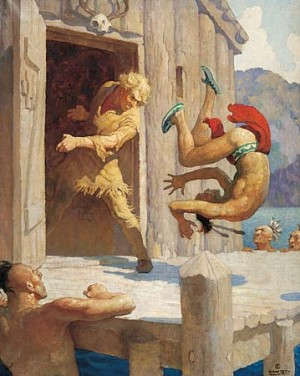
For those of you who snoozed through your grade school English classes, The Deerslayer is the last of the five books referred to as The Leatherstocking Tales, another of which is the more famous The Last of the Mohicans (1826), one of the most widely read American novels of the 19th century. Sadly, everything that Twain says about Cooper’s writing is absolutely true, despite the best efforts of N C Wyeth to make it seem otherwise.
“The Pathfinder” and “The Deerslayer” stand at the head of Cooper’s novels as artistic creations. There are others of his works which contain parts as perfect as are to be found in these, and scenes even more thrilling. Not one can be compared with either of them as a finished whole. The defects in both of these tales are comparatively slight. They were pure works of art.
–Professor Lounsbury
The five tales reveal an extraordinary fullness of invention. … One of the very greatest characters in fiction, Natty Bumppo… The craft of the woodsman, the tricks of the trapper, all the delicate art of the forest were familiar to Cooper from his youth up.
–Professor Matthews
Cooper is the greatest artist in the domain of romantic fiction in America.
–Wilkie Collins
It seems to me that it was far from right for the Professor of English Literature at Yale, the Professor of English Literature in Columbia, and Wilkie Collins to deliver opinions on Cooper’s literature without having read some of it. It would have been much more decorous to keep silent and let persons talk who have read Cooper.
Cooper’s art has some defects. In one place in “Deerslayer,” and in the restricted space of two-thirds of a page, Cooper has scored 114 offenses against literary art out of a possible 115. It breaks the record.
Thanks to Google’s forced “you vill be ready for ze mobile-friendly cutoff date of April 21 or you vill lose most of your ranking in searches” ultimatum, this website may look a little wonky over the next couple of days as I try out some different templates that are acceptable to our Google overlords.
When I was in college (in the 70s) I visited the London Zoo in Regent’s Park during a summer vacation. They had a wonderful indoor nocturnal exhibit, all sorts of critters in dark terrariums who were awake during visitor hours because their normal schedule was reversed.
It was, not surprisingly, dark in there. It was hard to read the labels. As I recall, there were reptiles, and bugs, and all sorts of things, but they hid in their foliage very well and half the time you couldn’t tell what was lurking in the greenery.
At the same time that I entered, a young father came in, carrying his toddler son up against his shoulder so he could see into the enclosures. The two of them followed directly behind me as we circulated along the edge of the exhibit.
I learned three things that day.
First, small children have a hard time trying to see something in a darkened terrarium. As far as the kid was concerned, he and his daddy were taking a walk in a funny dark place with lots of plants. Hints from his father didn’t help him (might not know enough words yet, I thought).
As I mentioned in the previous post, Dungeon Masters and Fantasy Authors both need to create characters, but DMs have software to help them.
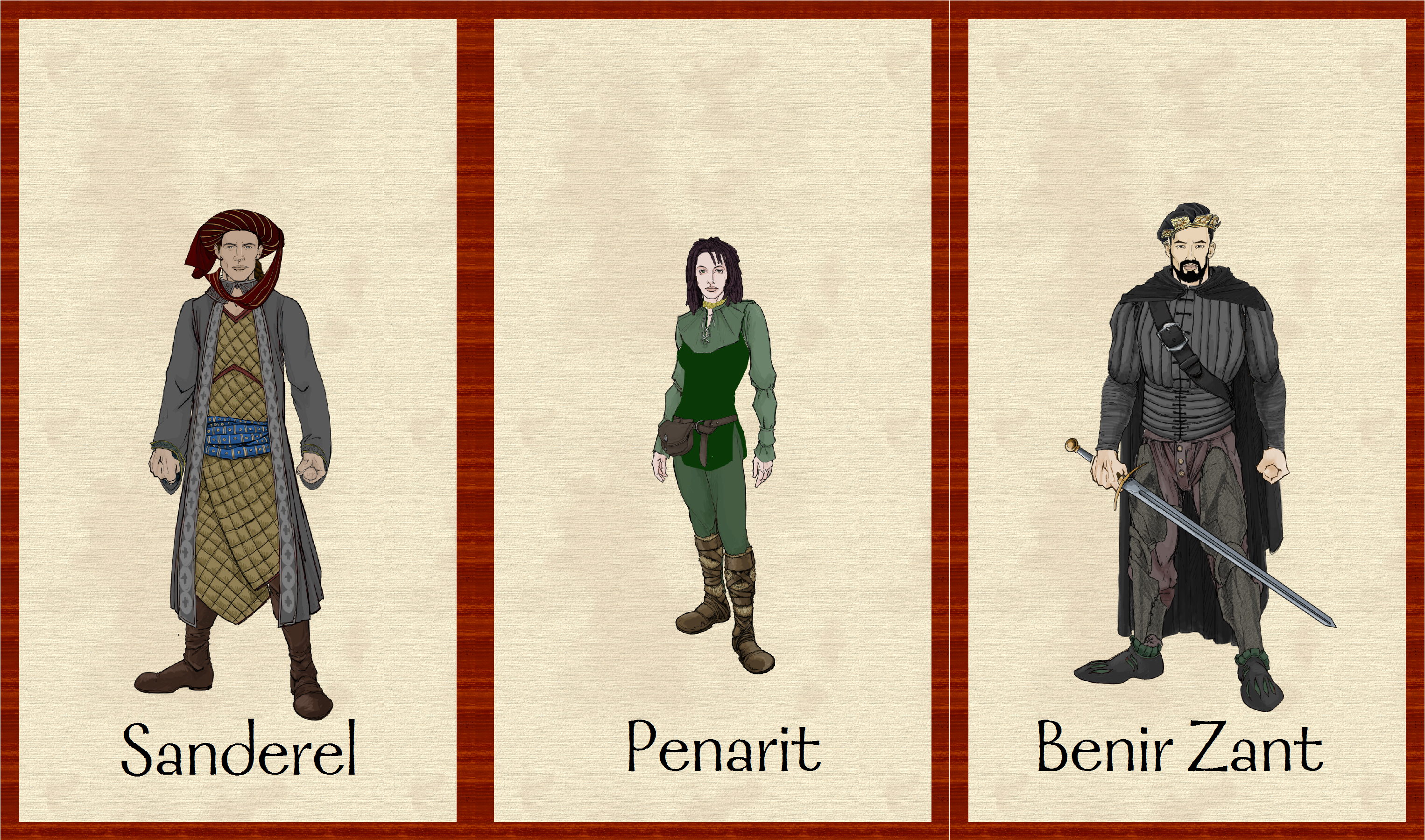
For my current series, The Chained Adept, I used a Character Card creator module from ProFantasy called Character Artist. Some writers browse the internet looking for photos that remind them of their characters, but I think that takes too long. I had much more fun coming up with an iconic “card” for some of the main characters in The Chained Adept.
These are not paper dress-up fashion dolls, and the choices are limited, but it’s surprising how much you can do with the given tools to provide a very quick sketch. While I don’t want to get too specific when describing a character for a reader, so that the reader can fill in much of the picture himself, I do find it helpful to get specific for my own view.
So, here’s what I think about my main character (Penarit), her companion (Sanderel), and the commander of the military unit they accompany (Benir Zant).
Of course, there’s one big difference between Dungeon Masters and Fantasy Authors. The DMs don’t care about keeping your character alive.
It’s a good thing you can trust authors. Most of the time. Unless that character really, really, needs to go.
Dungeon Masters can be cruel. So can authors with a long series.
Writers of fantasy and science fiction books have special needs. Not only do we have characters to create from scratch, like every novelist, but we have entire worlds to build — not just the verisimilitude of the historical past, but entire planets, spacecraft, or fantastic realms. Our desks are littered with bad sketches of landscapes, terrible character portraits, and far too many scraps of idiosyncratic cosmogenesis.
You know who else has these problems? Dungeon masters.
“Old school” dungeon design software
The world of Dungeons & Dragons and subsequent games created a need for game masters, those referees who control the world of their game for their players, to make maps, create character cards, and so forth. Not surprisingly, there’s an ecosystem of software to support this.
A couple of months ago, I invested in most of the software modules from ProFantasy and started playing around. I needed to design a complete secondary world for a new series, The Chained Adept, and it wasn’t going to be modeled on Earth at the geology level (although I planned to keep the flora & fauna so that the readers wouldn’t need to master an entire ecosystem of vocabulary).
I started by designing a planet, using Fractal Terrains 3. By providing a handful of parameters and tinkering with the results, you can create an infinite number of alien planets.
 I know I should be more blasé about it, more professional, but I’m only human. I’ve just signed my very first contract for a short story submission. Strange Horizons will be publishing “The Visitor” in an upcoming issue sometime in the next few months.