Visit Page
Skip to content

Category: Plot

Get your hero into trouble, and then make it worse

Posted in Just for Writers, and Plot

ABadDay-AchilleBeltrame

Good advice for all adventure writers.

Translation of the Italian:

In the middle of the Indian forest, a man waiting for the train to stop just near the line. Suddenly, a boa attacks its victim, squeezing with its powerful coils. But then a tiger hurls itself upon the huge reptile which wraps, then, even the beast in a stranglehold. A monstrous tangle occurs, meanwhile, along comes the train. The whole tangle winds up bloody and broken by the wheels of the train.

See NeverYetMelted for more details about Achille Bertrame and links to more bloodcurdling illustrations.

Hunting red deer

Posted in Plot, and Research

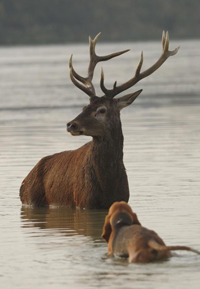
Red_deer_stag_2009_denmark-319x480As the readers of my Hounds of Annwn series have discovered, it's not fox they're after in the fae world, but other beasts of the chase.

The list of the royal beasts of hunting was always topped in the Medieval period by red deer, a close relative of what we in the new world call elk. (What the Europeans call elk, we call moose. Confusing, isn't it?)

I've seen a good bit of foxhunting in the last few years, but alas we do not (mostly) pursue deer with dogs in the US, and certainly not elk. So when I want to flesVenerieDuBarry-3-200wh out my understanding of the sport, so that I can incorporate it into the world of my books, I have to turn to those parts of the world where something similar still goes on. Vive la France!

There are many fine photographers who follow traditional hunting in France, by which I mean hunting on horseback, in livery, with horns, following a pack of hounds. Examples include Stéphan Levoye and my current favorite, Eric Dubos. Modern wrinkles include car followers dodging boar and crumpled French horns.

For more beyond this small sampling of images, please check out their websites.

VenerieDuBarry-300hVenerieDuBarry-2-300h


Nearing the end of The Ways of Winter

Posted in Plot, Production, and The Ways of Winter

I can hardly believe it but I'm almost there.

The first book in the series took from mid-April to early-September to complete, and then I spent a good bit of time on the learning curve of how to publish to 9 primary channels, which distribute to 36 retail channels, in 3 formats of ebook, and of course the trade paperback edition. I've only just started the process of contacting 700 independent bookstores, to add a few dozen (hopefully) to my list of local bookstores who've been kind enough to carry it.

I started the new book in early October, just as I officially released the first one. I was looking forward, in a somewhat leisurely fashion, to being much more efficient this time around in producing the versions for distribution, but I'm going to find out in a hurry, because this puppy is likely to be released in the first week or two of January.

First draft: Will complete this week. Total: 2 months. I'm stunned. (Keep in mind, I have a day job.) Heck, the editorial reviews for the first book are still drifting in, and will be for a month or more. My first drafts are near-final, so I expect to wrap this up with lots of polishing and proofreading roundabout Xmas. Give myself a week or two to format it into the editions, and off it will go.

I blame the 10-hour drive (each way) I did as I started the plot work, giving me uninterrupted time to really chew over the basic plot. Hurricane Sandy helped, too — a day without power let me concentrate on finishing the more detailed plot outline for the middle just when I needed to.

Won't be like this for the next book, though. That one will be longer and more complicated. I'm just chewing over the plot ideas now, but I can tell you one thing: much of it will take place in Gwyn ap Nudd's father's court, in the old world.

If you haven't finished reading your copy of To Carry the Horn yet, better hurry up! You wouldn't want me to write them faster than you can read them, would you?

Stay Tuned — There's a scene in The Ways of Winter that I'll post as a Xmas story. Our hero wants to cut himself a Christmas Tree, but no one in the fae otherworld has any idea what he's talking about.

Darkly kept secret

Posted in Plot, and To Carry the Horn

So here I've been reading lots of writers' blogs, listening to professional cautions and moans, trying to make sure I measure up appropriately to the expectations of my readers.

To heck with THAT. No one ever said what a blast it was doing the final quarter of a novel! That's what's getting me out of bed early every morning.

It's like watching your favorite long form TV show approach the end of its season and chewing on each week's episode, wondering how they will resolve the plot. That sense of time scale seems a closer match to writing than reading a book, which can be over in just a few hours.

Every day, as I commute, I get to chew on the plot so far and plan out the very next bits of it so I can write the scenes effectively the next day. And while I know roughly what will happen, details are constantly popping up (“oh, of course that's what he should do, that's how that gets tied in”) and it's always a surprise. The mind will provide, if you just plow the ground and sow it correctly (and make sure you're working on the right acreage).

The journey of the adult hero

Posted in Characters, Heroes, Plot, The Hounds of Annwn, To Carry the Horn, and Works

To kick off this new blog, I've decided to share a few thoughts about heroic plots involving non-juvenile heroes.

The typical journey of the hero involves a young man who follows a call and leaves his childhood behind him, maturing through action and conflict into a suitable, perhaps even great, adult. The plot is typically done with him once his path to maturity is complete. It's a young man's tale.

In To Carry the Horn, my current work in progress, the basic plot concerns George Talbot Traherne who is drawn from his Virginia countryside life to an otherworld populated by characters from Welsh mythology. George is 33 years old when the action starts. He is already mature, comfortable with responsibility, his character formed. How then can he become a hero, in the traditional sense of the plot?

The answer is in the deficiencies of the modern adult world versus the idealized world of heroic tales. For a youth in a traditional story, part of the challenge of becoming a hero is finding something worth doing, recognizing and growing into his proper place in the world. George, however, lives in a world all too real and mundane, where many of the basic adult responsibilities of manhood are watered down or absent. He has grown into a proper place in that world, but that world is not serious enough to satisfy him. It's too similar to the protected life of childhood that the youth in a traditional tale seeks to escape.

Perhaps if he lived a life of direct action (military, police, etc.) he might feel differently, but he is just an ordinary, good, competent man feeling constrained by the exigencies of modern life.

The otherworld provides him with scope for action, to explode out of his stunted growth into true maturity. He finds something worth the doing and eagerly seizes the opportunity. He can now build a foundation for a life worth living.