I’ve been a business entrepreneur all my life, primarily in the software and IT industries. In addition to building companies, I’ve had to build a working understanding of other industries and sectors in order to provide services for them: logistics, health care, educational testing, banks, brokerages, and several others. My businesses were small and mid-size, but most of my clients were large Fortune-500 sorts of companies.
I’ve prided myself on being able to dive into a new-to-me industry and burrow down into its basic gears and levers, so that I can analyze how it works. In many cases, I’ve had to understand it well enough to create software for it that would cover all situations, and that takes a deep understanding of what can happen.
So when I decided to become an independent author, I was cocky about applying the same acumen to the book trade. After all, I wanted to know all about how it worked and how to match my new business with it successfully. That naive expectation didn’t last long.
See that illustration? You know what’s wrong with it?
Readers don’t owe anything to authors, including thanks, and we shouldn’t presume that they do if we want them to continue as customers.
At least, that’s what I think. And here’s why.
Authors often seek recommendations on what to include in the back matter of their books. The potential list is long:
Thanking the reader
Asking for book reviews
Pointing the reader at links for more information about the book they just read
Offering the reader a newsletter to subscribe to, for information about books (with perhaps a bonus giveaway)
Offering the reader a way to contact the author (sometimes including links to social media)
Telling the reader about the next book in a series, or about another book
Presenting the first chapter of the next book in a series, or another book
One of these, the “ask for review,” was recently in the news as something that traditional publishers have begun including in the back matter of their books, apparently learning from independent authors.
When I first published my books in 2012 and for a couple of years thereafter, I also asked for reviews in the back matter, just as a standard practice, but I’ve stopped doing it.
Why would I do that? Don’t I want them to leave book reviews?
Let me explain…
Of course, I would like to have more reviews — who wouldn’t? But what I would like, even more, is for someone who has just finished a book to be eager to look at and buy my other books. That “bird in the hand” of a satisfied reader is far more important to me than another drop in the review bucket for a potential reader down the line. My customer is a customer first, way ahead of being a member of my marketing team.
I think asking for the review smacks of desperation and comes across as a bit unprofessional. I don’t want my reader to start thinking of me that way.
And you know what? It doesn’t make any difference to the number of reviews I get, near as I can tell. The review rate seems to be about 1-3% of units sold (I don’t do freebies), and that seems to be good across most current and active authors, trad or indie.
Think about what that means… That means that 97-99% of my readers didn’t leave a review. And every one of them probably felt a bit uncomfortable about it, if they read the request. Did that make them less likely to buy another book? Who knows?
Here’s my take on the psychology of it (aside from the vibe it sends)…
If the person is accustomed to writing reviews, then they’ll write one or not, regardless of what I say, just as if it were any other author’s book.
But if they’re not so accustomed, we’re asking them to change their behavior to accommodate us. We’re asking for a favor. But that’s not the transaction deal our readers make — the deal was, they give us money, and we give them entertainment.
Not everyone wants to learn a new behavior
It’s as though we only published ebooks and asked people who only read print to learn how to use a new format just so they can access our books. That’s asking them to change behavior, too.
Unless we are in the “super-cool, new trend” category and we’ve encountered a techie (and even then), asking people to change their behavior to do us a favor isn’t really going to work. And it may embarrass or guilt the recipient, which is not how we want them to think about us.
Better to just thank them, give them the “for more information” and newsletter signup links, and send them on to the “1st chapter of next book” with its link so they can buy the next one while they still like us.
I was talking to a colleague about missing metadata in an ebook file and discovered that she didn’t fully understand what I was talking about.
I’m sure she’s not alone.
So here’s a little overview about where it comes from and how it’s used. As they say, the devil’s in the details.
What metadata is visible to retailers?
Here’s an entry for one of my books at a random retailer I’ve never heard of. Since it seems to be in Romania, it probably got there via distributor PublishDrive. (Many retailers are worse, even those whose local language is English.)
PublishDrive asks all sorts of metadata information, just like Amazon KDP does, and this site seems to understand that the book is part of a series (The Hounds of Annwn), though its link to a series page points somewhere else in error.
Understandably, it doesn’t note which entry in the series it is (should be #1) since it doesn’t have a field for it on the screen.
I am fascinated to discover that the book is #4 in its category (especially since I have no known sales here), though less so when I realize (clicking on “Fantasy – Contemporary”) that my books are the ONLY books in that category, no doubt because it’s an English-language category.
In this case, note how few English fiction (EN – FICTION) books there are, and how Fantasy is displayed.
Constraints and remedies
Retailers can only display data they’ve planned for. If they haven’t planned for non-English categories, then they can’t use them (and won’t translate them on the fly or try to match them up to the local language). If they don’t have a field for series order (or sometimes for series name), then they won’t display it.
Even the best and most detail-oriented of modern distributors can’t shove fields (like series order) into retailer sites that don’t use them.
At the request of a colleague, I’m spending some time talking to some writers far, far away that she’s working with, and I thought it would be useful to collect the presentation in a blog post for them, and for anyone else who might be interested. You can find all the posts in this series here.
First step, install Skype.
I can’t possibly touch on more than a handful of topics in a single session, so I’ll just mention a few that I think are important:
As question/answers are added during the talk, I’ll update this.
Overview
I’m Karen Myers, and I’ve been a writer of fantasy and science fiction books for four years. I came to this late, after an official career building computer software and services companies that lasted four decades.
Just about all the best advice I’ve ever gotten came to me from people just a little further along on the same path, and I’m grateful to have the opportunity to do the same in my turn.
Whenever we send someone a book directly, or sell one at an event, we have an opportunity to include other things. Most commonly, these are bookmarks, which we also distribute wherever we can.
Business cards are also very useful to carry when you’re meeting people, or standing around at a convention.
What are they good for? How can we make them maximally effective?
Why bookmarks?
Bookmarks are the stand-alone representations of your books. They’re popular as leave-behinds in bookstores or at group events, and are the obvious choice for inserts into your books when you sell directly (via online ordering or at trade shows/events).
There is debate about whether all bookstores want them, but many do. If you’re not sure, ask.
What’s the goal of a bookmark? To interest someone in buying another book. You can’t list all your books on a bookmark, as though it were a mini-catalogue. That may seem plausible when you only have one or two books, but it defeats the purpose of seducing the reader with well-designed, professional information.
Instead, set up one bookmark for each series or important stand-alone book. Remember, when you start a series, you may not know how many books there will be, or what their names are. I created the bookmark above (using cover art from the first book) before I wrote a fourth entry and a story collection.
Focus on the first book of the series, name as many of the other books as you can without muddying up the image, and refer to “… and more” after that point. If you create a new bookmark for each series, you can be inventive about including a bookmark for series 2 in a book sale for series 1 to encourage cross-sales. Whenever you have any reason to mail something to someone, include a bookmark and a business card.
And since you may write faster than you use up a print run of bookmarks, future-proof them by using only digital contact information bits, not physical ones. I’ve moved since I made that bookmark, and I expect to move again before I run out of them.
Why business cards?
Let’s be blunt. If you’re in business and you don’t have business cards, how do you expect to support a professional impression? A business card is a courtesy to a potential buyer or colleague or vendor. It keeps them from having to write down your contact information themselves.
Better yet, it’s another opportunity to sell your product and seduce potential buyers.
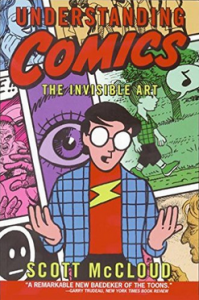
I’m rereading a wonderful book: Understanding Comics, by Scott McCloud. If you’ve never read it, stop reading this post right now and remedy the situation.
I’ll wait.
Don’t let the fact that he’s talking about illustrated work disturb you. His take on how to tell stories is directly related to the writing of fiction in all its forms.
In this post, I’ll focus on what he has to say about how the reader is your partner in story-telling.
As McCloud says about the above pair of panels (p. 66)…
Every act committed to paper by the comics artist is aided and abetted by a silent accomplice. An equal partner in crime known as the reader.
I may have drawn an axe being raised in this example, but I’m not the one who let it drop or decided how hard the blow, or who screamed, or why.
That, dear reader, was your special crime, each of you committing it your own style.
All of you participated in the murder. All of you held the axe and chose your spot.
To kill a man between panels is to condemn him to a thousand deaths.
Let me repeat that — the reader does the work; the artist merely sets it up. If you were writing a bedroom scene, think how little you actually need to show for the reader to fill in the details in ways far more vividly than you can conjure. It’s a very clear presentation of how less can be more.