Inspiration is all around you
Posted in Artwork
A Writer's Blog
Karen Myers is a fantasy and science fiction author, best known for her heroic fantasy novels. Her stories feature heroes in real and imagined worlds filled with magic, space travel, and adventure.
Posted in Characters, Structures of Earth, and The Affinities of Magic

I’m in the midst of the first book in my new series (The Affinities of Magic), and it’s a very different writing process from my previous book, which was the fourth in its series (The Hounds of Annwn).
I’ve gotten to know my primary characters in the older series pretty well. I know what they would and wouldn’t do, and a good bit of how they interact with each other. In other words, I’m comfortable with them.
In novels of adventure, the sort of thing I write, you need a good story, a sound plot, and it’s a good idea to have the basics of that in your head  before you begin writing. Perhaps the details are hazy — maybe you don’t know exactly how certain things are going to happen — but I find I need at least a sketchy outline of the key plot points before I can start. Some authors are comfortable just writing into the void, but I’m not one of them. (The lessons of Wile E Coyote are all too vivid.)
Plots in and of themselves don’t scare me. I used to be a serious software engineer, and what is that but the instantiation of a fully realized product where all consequences are knowable (at least, after debugging).
But story comes from characters, and that’s my current sticking point. Who are all these people?
From the talented Grant Snider. I try not to resort to the last panel too often.

Posted in Buntel Mayit, Monsters, Science Fiction, Second Sight, and There's a Sword for That

I find that long-form works like novels seem to match well with the sorts of stories I like to tell — multiple characters, various sub-plots, threads to be woven together. I wouldn’t dare try to keep two novels going in draft simultaneously. It would be like listening to two engrossing conversations at once, and impossible to keep track of.
But sometimes you just want a break. For me, that means writing short stories. Any shorts I write for my ongoing series will probably go straight to publication, but I’m also beginning to produce stand-alone short stories. Since the current series are in the fantasy genre, I’m doing the shorts mostly as science fiction, just for a little variety. Some are truly stand-alone (Second Sight), but others (Buntel Mayit, Monsters) are intended for a story collection called There’s a Sword for That, all of the stories for which will involve some sort of edged weapon. (Since swords are usually associated with fantasy, I thought it would be a challenge to produce science-fiction sword stories instead. That involves a wee bit more than just declaring, say, dragons to be aliens and getting on with it.)
You won’t see these stories for a while, since each one is going through the magazine submission process, and that takes quite a bit of elapsed time (more than a year, maybe two). But I expect to put a dozen or more stories out this year, and I entertain myself prior to publication with getting their covers done as I write them, so that there won’t be anything left to do after they come back unbought or their rights expire, if bought. At least I get to put the covers and blurbs up that way. And if I keep this up every year, there will soon be a regular stream of submissions coming back for publication — I’m just filling the pipeline this year to reap in the future.
Aiming for a certain size in a short story is not something I can control. They’re as long as they need to be, seems to me, and each one is different. Monsters, the latest story destined for the sword collection, surprised me by being only three pages long (1000 words), just two scenes, what they call “flash fiction”. My beta reader wanted to know what happens next, and perhaps you could spin a long story or novella out of it, or it could be the start of a longer character-based novel — sure, I could see that.
But sometimes a molehill is just a molehill, not a mountain. If the characters come back and start explaining their life story to me, well, maybe there will be a followup. Meanwhile, I like the unanswered questions that spin off from the brief encounter. Gives it a concentrated flavor, like a wound-up spring.
Posted in Artwork
Posted in Adaptability, Artwork, Monsters, Monsters, And More, Science Fiction, Short Story, The Visitor, The Visitor, And More, There's a Sword for That, and Your Every Wish
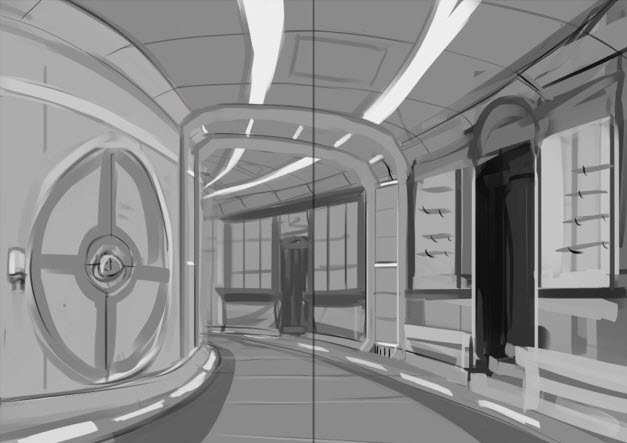
Over the next year or so I will be writing a dozen stories or more for a science fiction collection called There’s a Sword for That. It will feature bladed weapons, one per story, in unusual contexts, tied together by the shop that houses (and sells them) aboard a space station
The first story is Buntel Mayit, a tale of an ancient and famous keris (kris) cursed by the shaman/smith who was its first victim. Far in the future, it is still seeking revenge on dynastic opportunists. Captain Frans Krajenbrink, Keris Mpu Gandring, and the freighter Ken Arok out of New Java have a fateful encounter with an ambitious alien.
Each story will go through the submission process for magazines before being published by Perkunas Press, so it will be a while before you can read them. I’ll keep everyone posted as soon as any story becomes available in either magazine or Perkunas Press versions.
Meanwhile, here’s a look at the very first draft sketch for the cover of the collection, featuring the sword shop, from artist Jake Bullock who provided the cover for The Affinities of Magic.
Posted in A Writer's Desk
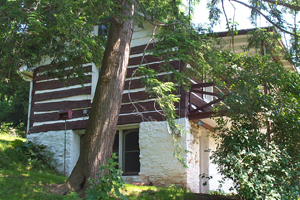 We have a family tradition, here at the cabin, of feeding the birds, in the wintertime and well into the spring. The main room downstairs, built into the hillside, houses the fireplace, kitchen, and all the comfortable chairs. From there we can gaze out through large windows at the birdfeeders, swaying gently on a pole, sheltered by the trees. You can see the red one in the picture, and we added another pole-hung feeder this year. Each pole holds the feeder about five feet from the ground.
The black bears also have a family tradition. Each year, in spring, while other food sources are still scarce and they haven’t been awake very long, they drop by looking for a good hit of sunflower seeds and flint corn. And if the humans are in residence, they generally find it.
My father-in-law lived in the cabin for about ten years. Each year he would report on the annual raid. If you think squirrels at the bird feeders are a nuisance, you should try black bear. Sometimes they would bend the pole down so they could get at the feeder more easily.
 So, this morning we glance out of the window, and the hanging feeder is not only down, it’s demolished, disassembled into various parts. I laughed smugly at the news, secure in the knowledge that the other two feeders I put up this year (very like this picture), that were suspended from a beam extending out from the bottom of the second story porch in front of the cabin, were intact. Until I turned my head to check that assumption.
Those feeders were not only pulled down from their beam, and separated from their top components, they were missing altogether. Unless that bear had a buddy or a duffle bag, I don’t see how it could have carried them both off.
Meanwhile, my desk looks out of that same window on the second floor that you can see in the top picture. I am surrounded by indignant cardinals, sparrows, nuthatches, finches, woodpeckers (suet was included), junkos, jays, and noisy chickadees, all looking for their breakfast and demanding a better level of service.
How do they do it? Perhaps you’ll find this link illuminating…
I imagine it was something like this. The dogs slept through it all.
If you want to keep score, see Human vs Bear, part 2.

(A shortened version of this post was published earlier here.)
A little less than two years ago I started writing my first fantasy novel. It has since grown into a series (The Hounds of Annwn) with four novels, five short stories, and a story collection, and I’m not done with it yet. I found a prolific Russian surrealist artist on the stockphoto sites whose work I admired, and I’ve used her images for all the covers (I have a minor level of competence in Photoshop, enough to design layout, fonts, and framing.) You can see those covers here.
I’m starting a new fantasy series now (The Affinities of Magic) and I know I’m not going to find a similar artist for the covers off the stockphoto sites, so this time I decided to commission cover art. It’s been a fun learning experience, and I couldn’t be happier with the results.
Like everyone, I started by asking for recommendations, and I sure got a lot of them. Unfortunately, almost none of them were in my genre (Fantasy), and there’s little that an excellent artist who specializes in photorealistic Romance shots can do to help me.
GENRE is the first and most important consideration. The purpose of a good cover is to (1) help the reader understand at a glance what genre the book is in, and (2) make the reader want to find out more (that’s where “quality” comes into play).

You need to know what the rules of covers for your genre are, so that you can signal appropriately to your potential readers. First step? Look at what other books in your genre look like. (See the above picture of a bunch of Fantasy books from Amazon – I added one of my older books as a comparison for legibility of Authorname. Click on this image or any other to see a bigger version.)
Fantasy as a genre tends toward illustrated covers instead of photo montage, though the ubiquity of stock photos is causing more photo-based covers to be created. One way to scream “Fantasy” is to use an illustration.
Pre-made covers and stock photo sites are therefore not good places to look for this genre, though suitable for others. I wanted an illustrator, and I was going to have to go it alone, learning as I went along. And I had a budget to consider…