Visit Page
Skip to content

Category: The Chained Adept

Out of the darkness, into the light

Posted in Characters, Plot, The Chained Adept, and The Chained Adept

Winding Path (Bob Kimball)

Endings are terrific.

I'm just finishing up The Chained Adept now, having extricated myself from the swamp of my misconceived 3rd act. I love doing endings. I know exactly where I'm going, what's left to do, and what I need to wrap up.

Some genres, and some authors, too, like to end their books with a bang. Kill the villain, defeat the army, save the alien princess — done!

I find that I prefer a bit of a cool down at the end, a reflection on what's happened, perhaps the foundation of a new vector for the next book. My characters need it, a way to recover from peril and stress. (As one of my friends would say with a wink and a leer, “it's just not the same if you don't get to smoke a cigarette afterward.”)

It's the light my characters work toward, whatever form that takes, whatever the darkness that impedes them. They need some of that light at the end to sustain them.

Valar Morghulis

Posted in Characters, Heroes, Plot, The Chained Adept, and The Chained Adept

ValarMorghulis
“All Men Must Die” — The motto of George R. R. Martin's Game of Thrones

We're part way through a multi-day marathon of the entire 5 or 6-season run of Game of Thrones on cable, and it's been on non-stop for the last couple of days, downstairs in this small cabin. Periodically I go and get some lunch or dinner, and make sure my husband is still breathing, in front of the TV.

No doubt about it — this is quality programming, and I've seen all the episodes (and read the books). Upstairs at my writing desk, where I can hear snatches of the dialogue, much of the music, and all of the screaming, I'm having no trouble following along with the episodes as they go by.

This is having two effects on my writing…

I am oh-so-glad that George R R Martin is not the god of my personal universe

When novels first became popular in the 16th/17th century, readers felt that they held up a mirror to life. My opinion is: yes, and no.

Yes, in that the characters must emulate real people, or the story they tell has no foundation, no reality, and is nothing but fable, with puppets moved at whim by the author.

No, in that the author is the god of his created world, and it is only a pretense to abdicate that responsibility. It is not fate that kills his characters, or accident, or evil — it is the author's pen, disclaim it how he may. Even when writing a novelized version of historical events, the author cannot help but take sides, offer explanations, create a reality where the events make some sort of fictional sense. It's his story, and he has shaped it as he wants it.

Words and history

Posted in Fantasy, Language, The Chained Adept, and The Chained Adept

Anachronisms
Anachronisms

There's one thing a writer of fiction learns early — don't knock a reader out of your story because of words that mean what you want, but that the character would never have used.

If you're writing a work of contemporary fiction, that usually means matching your dialogue to your characters. The impoverished nine-year-old is not likely to use gold-plated words, except perhaps as a comic gesture.

For non-contemporary fiction, the bigger problem is anachronism. When you remember that “khaki” comes out of British imperial rule in India, you are well-advised to avoid it as a descriptive term in a book on the Crusades, or in a fantasy world where neither Britain nor India have ever existed.

When I read books, I find the worst offenders are phrases based on technology that the author forgot is modern, or at least, too modern for the context. “He's never learned to put on the brakes”, “He's just blowing off steam”, “He's a real live wire, isn't he?” — these are a slap in the reader's face in the wrong context.

Lost in the tepid swamp of niceness

Posted in Plot, The Chained Adept, and The Chained Adept

Lost in the swamp

There you are, writing along at a good clip, and suddenly you find your story buried in mud, all its energy lost.

Now, I'm still rather new at this fiction writing life — a bit shy of my first million words. Aside from working on the craft itself, which I enjoy, much of the challenge is understanding your own psychology well enough to control your productivity.

In my case, there are two issues: what to do when the story grinds to a halt, and how to avoid procrastination. Now, I don't know anyone who can successfully discipline their work habits through will alone (if we had that much will, we'd all eat healthy and exercise regularly, not to mention watch our budgets and clean our houses). Most of us are better off coaxing ourselves into a regular routine and lowering all barriers that might derail it.

Alas, I have an alarm system that slams a wall down in front of my creativity when it senses “wrong path taken” for the story. I push my way forward from that point with great difficulty and at my peril, and I've found it's always a mistake to do so.

Decorative elements for The Chained Adept

Posted in Artwork, and The Chained Adept

One of the pleasures of working with a cover artist is that you can request extras as part of the arrangement.

For the series of which The Chained Adept is the eponymous first entry, I asked for my usual decorative bits for inside the book (ebook and print).

ChainedAdept-Extras-SketchesThe top one will get used for the Title page and for the End-of-Book marker, before any name index or other back matter.

The middle one will be used as a Chapter divider, and the bottom will be a Scene separator.


Building the world of The Chained Adept – Part 2: Characters

Posted in Characters, Fantasy, and The Chained Adept

Part 1 is here.

As I mentioned in the previous post, Dungeon Masters and Fantasy Authors both need to create characters, but DMs have software to help them.

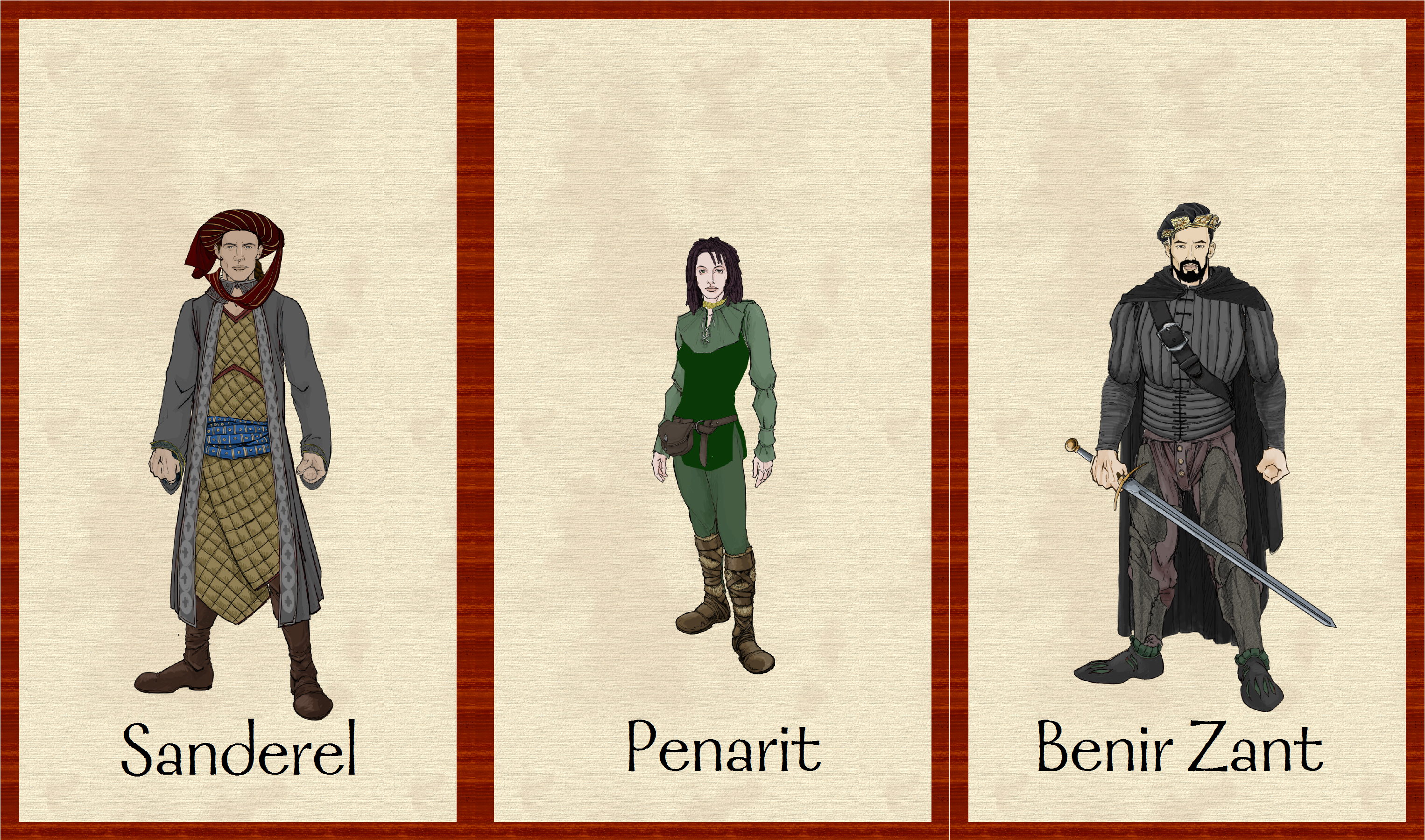
For my current series, The Chained Adept, I used a Character Card creator module from ProFantasy called Character Artist. Some writers browse the internet looking for photos that remind them of their characters, but I think that takes too long. I had much more fun coming up with an iconic “card” for some of the main characters in The Chained Adept.

These are not paper dress-up fashion dolls, and the choices are limited, but it's surprising how much you can do with the given tools to provide a very quick sketch. While I don't want to get too specific when describing a character for a reader, so that the reader can fill in much of the picture himself, I do find it helpful to get specific for my own view.

So, here's what I think about my main character (Penarit), her companion (Sanderel), and the commander of the military unit they accompany (Benir Zant).

Gallery

Of course, there's one big difference between Dungeon Masters and Fantasy Authors. The DMs don't care about keeping your character alive.

It's a good thing you can trust authors. Most of the time. Unless that character really, really, needs to go.

Dungeon Masters can be cruel. So can authors with a long series.

Building the world of The Chained Adept – Part 1: Maps

Posted in Fantasy, Science Fiction, Setting, and The Chained Adept

Writers of fantasy and science fiction books have special needs. Not only do we have characters to create from scratch, like every novelist, but we have entire worlds to build — not just the verisimilitude of the historical past, but entire planets, spacecraft, or fantastic realms. Our desks are littered with bad sketches of landscapes, terrible character portraits, and far too many scraps of idiosyncratic cosmogenesis.

You know who else has these problems? Dungeon masters.

Old school dungeon design software
“Old school” dungeon design software

The world of Dungeons & Dragons and subsequent games created a need for game masters, those referees who control the world of their game for their players, to make maps, create character cards, and so forth. Not surprisingly, there's an ecosystem of software to support this.

A couple of months ago, I invested in most of the software modules from ProFantasy and started playing around. I needed to design a complete secondary world for a new series, The Chained Adept, and it wasn't going to be modeled on Earth at the geology level (although I planned to keep the flora & fauna so that the readers wouldn't need to master an entire ecosystem of vocabulary).

I started by designing a planet, using Fractal Terrains 3. By providing a handful of parameters and tinkering with the results, you can create an infinite number of alien planets.

The World of the Chained Adept
The world of The Chained Adept