It’s wintertime, there’s a helluva lot of snow on the ground, and my 4WD car is in the shop. So, when it comes time for groceries and the liquor store, we have no alternative but to take our big old Ford F150 pickup truck, with its snow plow attached, down off the mountain and go lurching into town.
It looks a lot like the picture, but decades older, with a much (much!) longer bed.
My husband has a hard time getting around, so I usually go with him to run in and out of the stores. He does the parking.
It’s hard to turn off the writerly brain a lot of the time, and I’m usually yanked from a writing session to “go run errands”, so I’m typically still writing in my head as we hit the road.
There we were, trying to find parking along the streets of this small, narrow town (since there’s no getting that vehicle into most Main Street parking lots). He began backing into a slot on the street, and I was impatient to hop out and let him finish that while I started the errand in the store. But, no, he didn’t pause to let me do that — he concentrated on the mechanics of the parking and left me fuming in frustration until he stopped and I could get started.
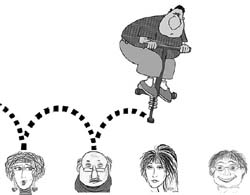
And then it hit me. I wanted him to leave out the boring bits of the scene and go straight to the action. What a pity we can’t do that in real life.
Puzzled writer – where did I first mention his broccoli phobia?
[UPDATED 9/19/2014 to reflect comments & suggestions from Scrivener support.]
A recent discussion on a Scrivener Facebook group put me together with another systems engineer type (Ronnie Darby), and the two of us had a long Q&A about the process mechanics of creating a book series bible based on Scrivener but utilizing the strengths of Scapple as well as Aeon Timeline. Ronnie was already doing this, and I bounced off his concepts to create a process for my own work.
A series “bible”, for those not familiar with the term, is a reference document that contains everything about a series (book or TV) except for the actual text/content. Think of it as meta-content.
For readers who don’t know all of these tools, here’s a very quick summary.
Scrivener is considered by many to be the premiere tool for writers. It provides a platform for not just book content, but also for research materials, character templates, and a whole lot more.
Scapple is a freeform note-creation tool, by the same folks who created Scrivener. People use it to create, for example, maps of character relationships.
Aeon Timeline is a product that allows you to lay out events, subplot arcs, characters, etc., along a timeline grid. It’s used for various scheduling activities but also for organizing the timeline of narrative works.
Each of these products is reasonably priced, with an extensive uncrippled free trial period. They run on both Mac and Windows.
For the purposes of this post, I will assume you have some familiarity with Scrivener. There are other products that do much of what Scapple does, and there are other timeline products, but these are the best I’ve found for supporting narrative writing. The principles and structure I lay out here are suitable for other tools used in conjunction with Scrivener.
I am running on Windows, and my discussions of file structures will therefore be a bit different than for Mac users.
Basic Assumptions
The primary goal is to facilitate finding what was said or described in other books in the series, combined with the ability to brainstorm as part of the creative process, in order to achieve consistency among the books in the series and to save time researching past work. To that end, it is useful to separate the written words of the books produced (content) from the supporting material (meta-content).
The process described below assumes you will:
Use a Scrivener Project for each Book in the Series that contains only the book content, e.g., Scenes and Chapters.
Use a Scrivener Project Bible for the Series that contains everything else, for the entire series (Character templates, Research, etc.)
Use Scapple to create & maintain networked Character (and other entity) relationships.
Use Scapple to brainstorm character relationships and important events.
Use Aeon Timeline to keep track of important events.
One of the great benefits of the resurrection of the backlist into permanent life in the last few years is the ability to buy an entire series and read it, in one big gulp, as if you were binging on a Netflix series season. Unfortunately, when an author adds one book per year to a lengthy series, you see many things over the course of the few days it takes to read them that the author did not, and not every author bears this sort of scrutiny. I was worried when I reread the Travis McGee books, in the John D. MacDonald series, but those held up well. Robert Parker’s Jesse Stone on the other hand…
Parker’s main books were the Spenser series and I enjoyed them for many years, until they began to seem mannered, repetitive, and tedious. I had never tried the Jesse Stone series, his “B” hero, until the movie specials of eight of them were broadcast by CBS, with Tom Selleck in the lead role. The movies, which I thought were well done, got me interested in the books, and I have just finished a two-week read of all of them.
Night Passage (1997) – Berkley (Penguin)
Trouble in Paradise (1998) – Berkley (Penguin)
Death in Paradise (2001) – Berkley (Penguin)
Stone Cold (2003) – Berkley (Penguin)
Sea Change (2005) – G P Putnam Penguin
High Profile (2007) – G P Putnam (Penguin)
Stranger in Paradise (2008) – G P Putnam (Penguin)
Night and Day (2009) – G P Putnam (Penguin)
Split Image (2010) – G P Putnam (Penguin)
Parker completed nine books in the series before his death in 2010, and they are still being continued by other authors. (I’ll just cover Parker’s books in this review, not the continuations.) They represent his latest work.
Where was the editor?
Head-hopping
The Jesse Stone books were apparently Parker’s first foray into 3rd person point-of-view, and there are many technical errors related to dialogue and POV that any editor should have caught, especially these mainstream publishers.
In particular, there’s occasional head-hopping from paragraph to paragraph and, disconcertingly, dialogue from multiple speakers in the same paragraph. These are elementary, easily corrected mishaps, but they made it all the way to print.
I also take exception to the concept of one scene per chapter, when the scenes are typically 3 pages long. A Jesse Stone book with 200 pages will have 60-70 chapters.
The world of Jesse Stone
Not even these guys all talk the same
There’s no question that Parker can write, and write well. Part of the charm of this series (and of the Spenser books, too) is the clever dialogue. Jesse Stone is laconic, witty, and absolutely unmistakable when you hear him. The problem is, so is everyone else he talks to, as though they were just projections of his personality.
At least half the characters around him speak exactly the same way he does. While a certain amount of that might be influence from our hero, we’re way beyond that effect: half the people in his department (he’s chief of police in a small town), his colleagues, his shrink, several of his girlfriends, and even a few of the villains all indulge in volleys of two or three word phrases with him. It’s all witty enough that the reader is amused, until he stops to think about it.
We live in Jesse Stone’s world while we read the series, and adapt to the artifice of the dialogue tic. It’s a mannerism peculiar to Parker — the Spenser books are exactly the same, with the banter between Spenser and Hawk or Spenser and Sue Silverman. It reminds me of the stage dialogue of a couple of centuries ago for comic sidekicks.
Another Irritated Review™, this time for an Historical Scottish Romance work. (No, the unnamed author is not Diana Gabaldon.)
Things not to do when simulating a time period remote from the present…
The sanitary 1300s
Wouldn’t catch him bare-chested — it’s cold!
Our heroine has escaped from south of the border into the highlands on horseback. Considering that probably half the children would have died of disease in childhood, we encounter remarkably few smells, no lice, nary a bit of spoiled food, etc. Why, it’s just like now.
In fact, it’s warm in Scotland, see, and apparently free of biting insects, for our hero is bare-chested for his initial (and several later) encounters with the heroine. With his sword slung over his back. All those blisters from the leather sling chafing his bare flesh must be really attractive. Sort of surprising that he never does anything about it, like put on a shirt.
Dances have a history, too
This is what dancing was like in the 1500s, two centuries later
Couple dancing, with men lined up to ask for the next dance weren’t really a feature of the 1300s. It would appear that someone read Jane Austen or some derivative Regency romance and assumed those dance settings applied five hundred years earlier.
The best part was when the heroine is taught by the hero how to dance and she carefully counts “1 2 3, 1 2 3” to help remember the steps. I hate to tell the author, but the waltz is a dance from the late 1700s-early 1800s. (There’s that Regency thing again.) 200 years ago, 700 years ago — what’s the difference?
In the middle of the Indian forest, a man waiting for the train to stop just near the line. Suddenly, a boa attacks its victim, squeezing with its powerful coils. But then a tiger hurls itself upon the huge reptile which wraps, then, even the beast in a stranglehold. A monstrous tangle occurs, meanwhile, along comes the train. The whole tangle winds up bloody and broken by the wheels of the train.
See NeverYetMelted for more details about Achille Bertrame and links to more bloodcurdling illustrations.
We’re often blind to our own faults. I find it easier to see problems in the works of other people, especially now that I have a hard time turning off my editorial eye when reading fiction (the downside of being a writer).
I can forgive a few typos, and the occasional fluffs, like a gun that starts as a .22 and ends up as a .357 — these are understandable mistakes. They’re errors of execution, not of understanding. But there are limits…
Here, for your amusement, are some things I encountered in last night’s book which I’ve sworn never to do myself. I’ve spared the author name and book title, since the point is not to heap scorn upon the efforts of someone else but to go and avoid these problems myself.
I’ll post more of these Irritated Reviews™ from time to time, when sufficiently provoked.
The no-muss-no-fuss death in the family
The tops of the Blue Ridge mountains have no rivers
This thriller is set in the unnamed mountains of North Carolina (presumably the Blue Ridge). Our heroine has returned home, after the recent death of her last parent (no siblings), to her architectural home perched high up in the mountains with a view of chasms. Her family is one of the founders of the town nearby, and her home has lots of land.
She works for a living, no reference to independent means. There is no mention of inheritance, estate taxes, or any duties involved in dealing with the death of her mother, other than a funeral. No mention of property taxes, which would likely be substantial. Hard to believe she’s the last surviving member of her family, or that she can support the house, or that there has been a death of a parent just weeks ago with its necessary financial impacts and unfinished tasks. Doesn’t seem to have any new inherited money or financial responsibilities. It’s a shallow plot device to give her an interesting home, but since it has none of the reality of supporting such a home or the passing of the torch, she operates in an unbelievable financial vacuum.
The river on top of the mountain
The most river you’ll see high up on a mountain
Her high school boyfriend takes her to a cabin higher up the mountain to reminisce about old times. It sits along a river, and there’s her old canoe.
Now, in my experience, navigable (even if just by canoe) rivers do not appear high up on mountains, even the modest Blue Ridge ones.
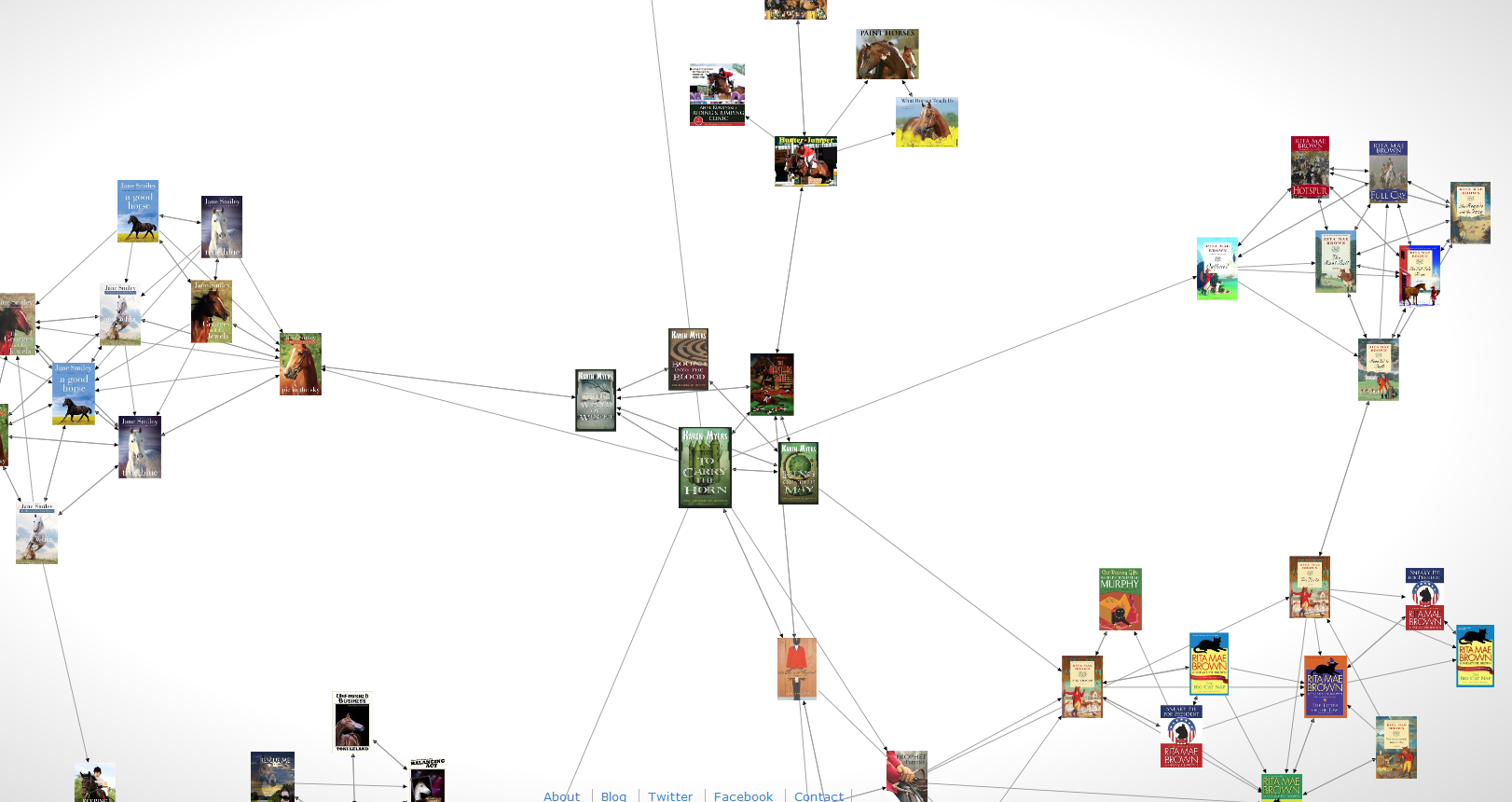
I’ve just encountered a tool (new to me) for checking the Amazon “also bought” lists that point back at your books: Yasiv.
Print
I typed in the name of the first book in my first series under Search Category = Books, and was fascinated to see how my readership broke down.
The series, The Hounds of Annwn, is a contemporary fantasy involving a Virginia foxhunter who ends up in the fae otherworld leading the Wild Hunt. Now, as it happens, I spent several years as a semi-pro photographer following the Virginia hunting scene, so when I published To Carry the Horn, the first book in the series, I had a ready-made audience of foxhunting enthusiasts who already knew me from my photography.
Many of these people have never read fantasy (beyond, say Harry Potter) and bought the series out of horse-related interest. The people who were already followers of Rita Mae Brown’s foxhunting mysteries, with their fantasy elements of talking animals, were especially susceptible. There weren’t any other fantasy readers who bought print editions where I showed up in their “also-boughts.”
I’m a writer of Fantasy and Science Fiction, not a horse or hunting mystery writer, but I chose this first topic as a bit of a crossover to appeal to my built-in audience so that I wouldn’t have to start from scratch to build a fantasy audience, figuring my next series would be a more conventional fantasy (which it is).
Ebook
I already knew that many of the first series readers didn’t do ebooks and would be responsible for most of my print sales. What I didn’t fully realize until now was how little connection there was between my print and my ebook audience.
I converted to using Scrivener (from Word) more than two years ago and have never regretted it. It’s a wonderful dedicated platform for writing.
Today I want to talk a little about how I use it to track loose ends that I’ll want to fix later. I’ll start by talking about Scrivener scenes.
A typical structure for a Scrivener novel project is to organize it by chapters and scenes, with scenes being the smallest unit. For my purposes, I have created a scene template which I use for each scene that has a Notes structure already in place to help me remember what’s important in each scene.
Once the scene is done, I copy the material above the dashed line into the Synopsis box as a description of the important parts of each scene. That’s what’s visible in higher-level views when you’re rearranging scene order.
Let’s go over each of these items in detail.
POV – Identifies the point of view character. I also have a special Label (above) for scenes by POV character.
SUMMARY – A couple of lines about the scene.
SPECIAL MENTIONS – anything crucial to the plot, like clues or back stories
GOAL OF POV – What the POV is trying to achieve in the scene.
CONFLICT OBSTRUCTING – What is standing in the POV’s way.
STAKES (WHAT-IF FAIL) – What will happen if he fails.
FORESHADOW – Explicit foreshadowing of some future event.
LOOSE ENDS – Something that needs to be cleaned up.
Of course, not every scene uses all of these notes, but they’re a helpful reminder as I plot the scene out — if I don’t know what’s going on, how can I expect my reader to follow along?